
Skip to content
FR
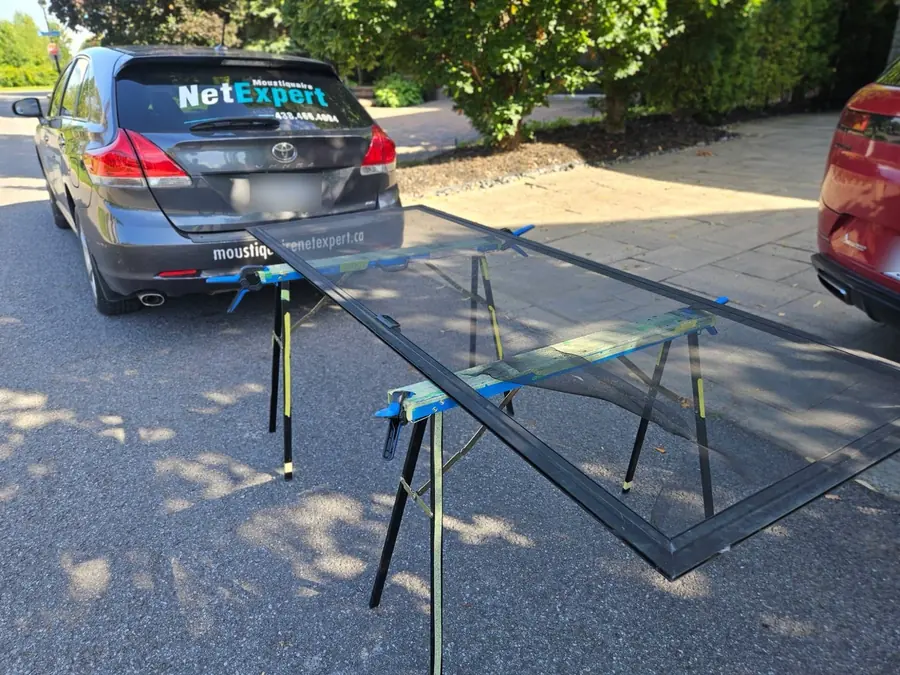
Rescreened patio door on trestles in front of the Moustiquaire Net Expert vehicle

Patio door screens

Patio door screen: repaired at your home, in its own frame

The sliding screen door is the hardest-working screen in a house: it opens and closes several times a day all season long, and it takes the wind, the sand and the dog’s paws. When it jumps the track, drags or lets mosquitoes through, we repair it on site — mesh, rollers, track and hardware — without replacing the door.

  • Repaired at your home
  • 1-year warranty
  • 7+ years in the trade
  • April → October
Free quote

Describe your screen, we call you back

Three questions are enough to start. The official measurement is taken on site.

  • Free, no commitment
  • Repaired at your home, in your frame
  • Photos and dimensions optional
  • 1-year written warranty

Request a quote

Three minutes, and you have a price. No commitment.

No commitment · Quick reply · Work guaranteed 1 year

The trade

Why it is the most common repair in the trade

A window screen sits in place all season without being touched. The patio door screen moves every time someone steps onto the deck: it gets slid, slammed, and shoved with an elbow when hands are full. All that movement rides on two small rollers and a track at ground level — the most exposed parts in the whole house.

It is also the only screen that pets go through. A dog that wants out pushes the mesh with its nose; a cat that wants in digs in its claws. A window screen never sees any of that.

The result: when someone calls us about a screen, it is very often the patio door. And that is rather good news, because its failures are well known, can be recognized in a few moves and are repaired in the existing frame.
Diagnosis

The four patio door failures

Almost everything that happens to a sliding screen door falls into one of these four families. Each has its symptoms, and each is fixed on site.

01

Slack or torn mesh

What you see

The mesh billows in the wind, has pulled out of the spline in one corner, or has a tear at the bottom — where feet, the dog or the broom go by. Slack mesh also leaves a gap along the frame that mosquitoes walk through with no effort.

What we do

We remove the old mesh and its spline, clean the channel, stretch new mesh and lock it in with spline of the right diameter. The mesh is chosen for how the door is used: standard, pet-resistant or aluminum. The frame stays yours.

02

Worn rollers

What you see

The door drags, jumps the track, scrapes at the bottom or leans to one side; you lift it to get it past. A roller is a spring and a nylon or steel wheel: the spring tires, the wheel flattens or seizes, and the door is no longer carried.

What we do

We replace both rollers with a model compatible with your door, then set their height so the door rolls straight and latches without being lifted.

03

Dirty or bent track

What you see

The door rolls in jerks or always sticks at the same spot. The bottom track collects sand, pet hair, pine needles and leaves; a trapped stone or a kick bends it over a short length, and the roller drops into it on every pass.

What we do

Full track cleaning, a dry lubricant that does not hold dust, and light straightening of a bent track when the metal allows it. If the track is too far gone, we say so plainly: rolling on it wears out new rollers before your eyes.

04

Broken handle and latch

What you see

The handle hangs loose, the latch no longer catches in the strike, or the door unlocks at the first gust. Screen door hardware is plastic or thin zinc and lives outdoors: the sun weakens it, and one slam too many breaks it.

What we do

Handle, latch or strike replaced with a compatible part, and the latch bolt adjusted so the door closes in one motion and stays closed.

The question on every call

Rollers or mesh? Often both, in the same visit

The question comes up on every call: “my door jumps the track — is it the mesh or the rollers?” When a door comes off its track, it is the rollers. Mesh does not derail a door; it lets insects in. But the two age at the same pace, because they live through the same door, the same sun and the same seasons.

That is why, when we take a door down to change its rollers, we look at the mesh — and the other way around. A door with new mesh that jumps the track again the same evening is not repaired. A door that rolls like new with mesh that gapes is not either. Replacing both while the door is off saves taking it down again, and paying two trips for one problem.

We never replace a part that does not need it: if the rollers turn true, they stay. But if they show wear while the door is on the trestles, we show you and you decide, part in hand.

The meshes

Which mesh for your patio door

The same door can take three different meshes. The right choice depends on who goes through it.

Most common

Standard fibreglass mesh

Supple, discreet, the most common. It suits a door in normal use, with no pet leaning on it. It tensions well in an original frame and keeps a good view of the deck.

Cats and dogs

Pet-resistant mesh

Thicker and more tightly woven, in coated polyester: it stands up to a cat’s claws and to a dog’s nose pushing to get out. It is the mesh we recommend as soon as a pet goes through the door several times a day. It shows a little more than standard; that is the price of peace of mind.

Wind and exposure

Aluminum mesh

Rigid, it neither sags nor tears under a light knock. It suits doors very exposed to wind, or when you want a frame that stays taut for a long time. The trade-off: a sharp blow dents it for good — we keep it for doors where suppleness is not an advantage.

The full detail on meshes — visibility, weave, behaviour in the sun — lives on the window screen repair page.

Our principle

We keep the frame

A complete screen door is sold at the hardware store, and the first instinct is often to replace the whole thing. Almost always, that is unnecessary: a patio door’s aluminum frame is sturdy, and it was made for your tracks. A new door that is “about” the right size drags, will not latch and ends up leaning against the deck wall.

As long as the frame is straight and its corners hold, we work inside it: new mesh, new rollers, new hardware — the door is as good as new, and it is the right one. A frame twisted by a fall or a forced door is the only reason to build a custom door, to the exact dimensions of the opening.

Real jobs

Two real jobs, from diagnosis to result

The photos below are ours — our trestles, our tools, our hands, no stock images. A door whose original frame was put back in shape, then a frame built new for when the old one cannot be saved.

See all our work
Job 1

Patio door: the original frame put back in shape

The mesh had given out in the middle, a corner of the frame had opened — the weatherstrip pile was hanging loose — and the rollers were seized. The original frame was worth keeping: taken down, cleaned and squared up on the trestles, new rollers, new mesh. No door to buy.

  1. Patio door screen removed and laid on two trestles in the street, torn mesh, in front of the Moustiquaire Net Expert vehicle1
    On arrival: the door off its track, mesh burst in the middle
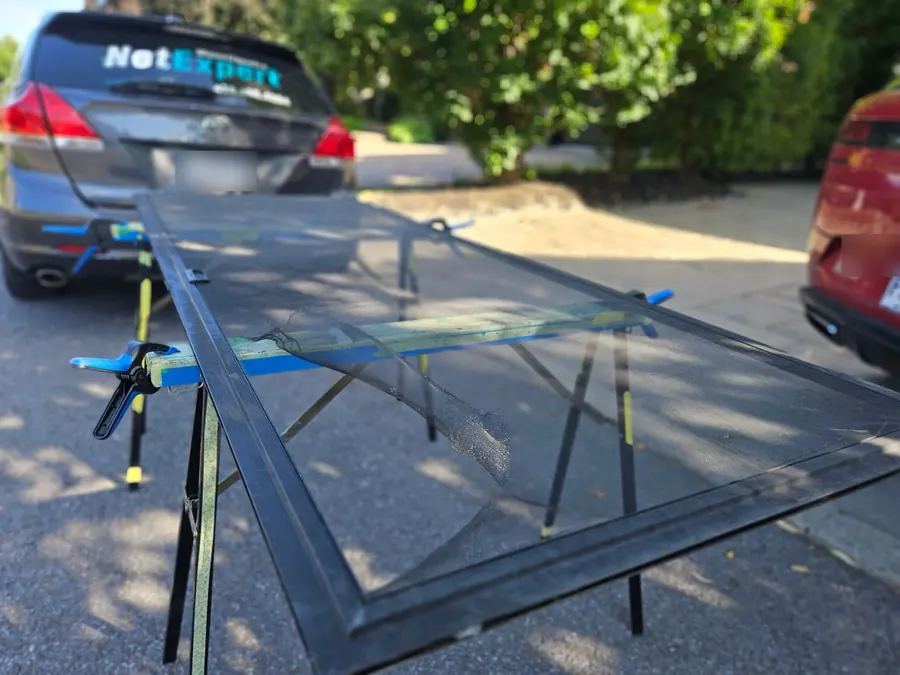
  2. Close-up of the torn, sagging mesh of a patio door screen resting on the trestles2
    The mesh: torn and slack, it no longer keeps anything out
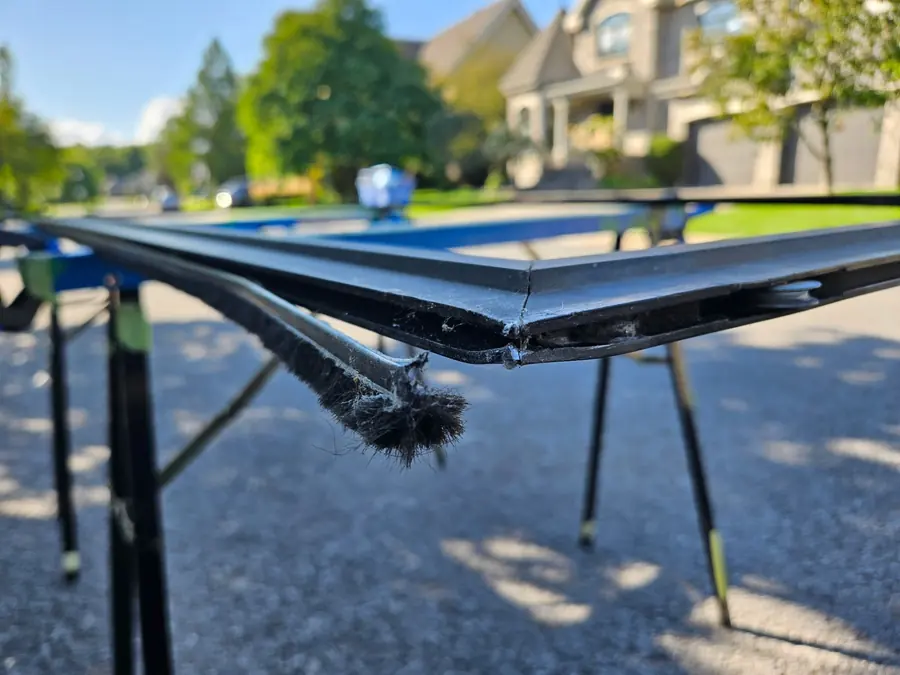
  3. Patio door frame corner come apart, black weatherstrip pile out of its groove3
    The corner: the frame has opened and the weatherstrip pile hangs loose
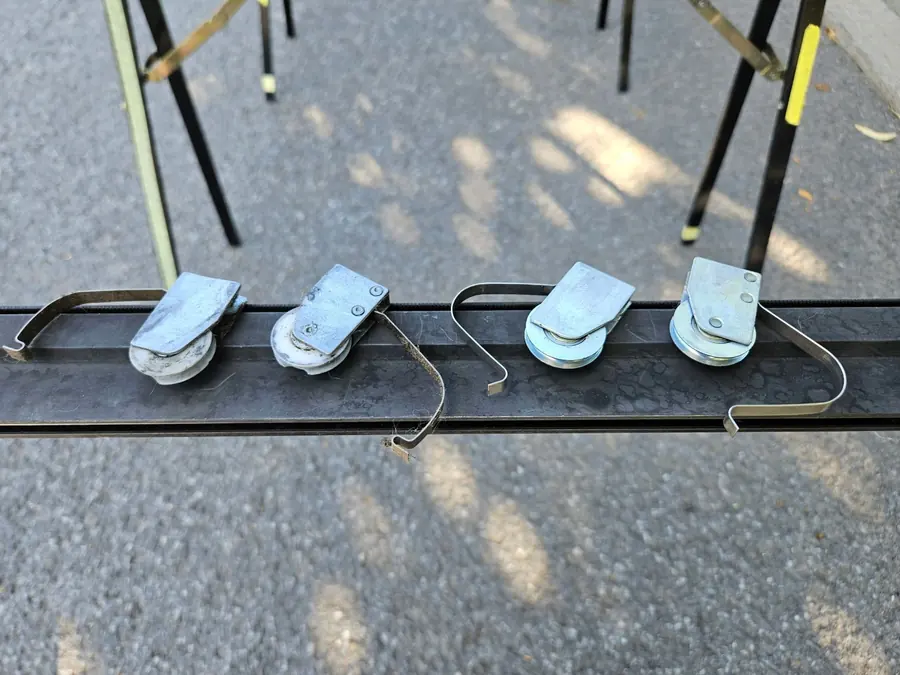
  4. Four patio door rollers lined up on the frame: two old ones in grimy white plastic, two new steel ones4
    Rollers: the two worn ones on the left, the two new ones on the right
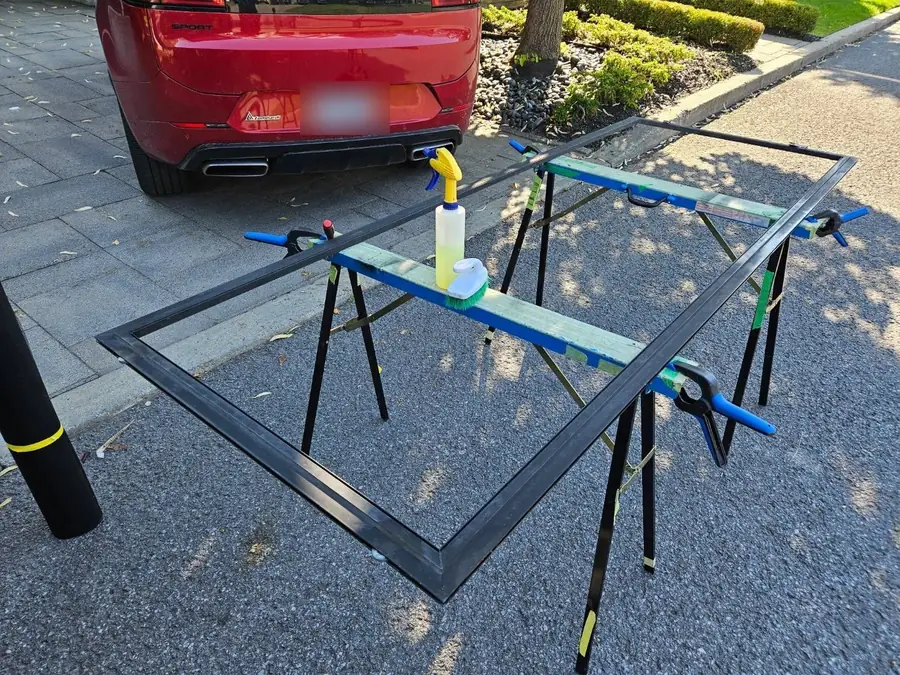
  5. Bare patio door frame on trestles with a spray bottle and brush on top5
    The frame stripped and cleaned, before reassembly
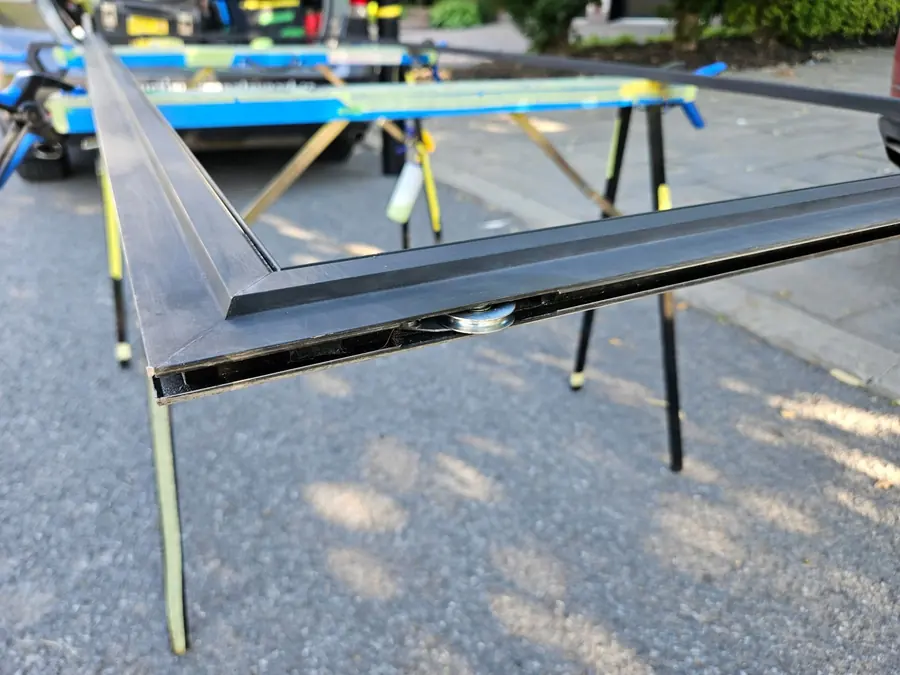
  6. Patio door frame corner closed up, new steel roller visible in the track6
    Corners closed back up, new rollers in place
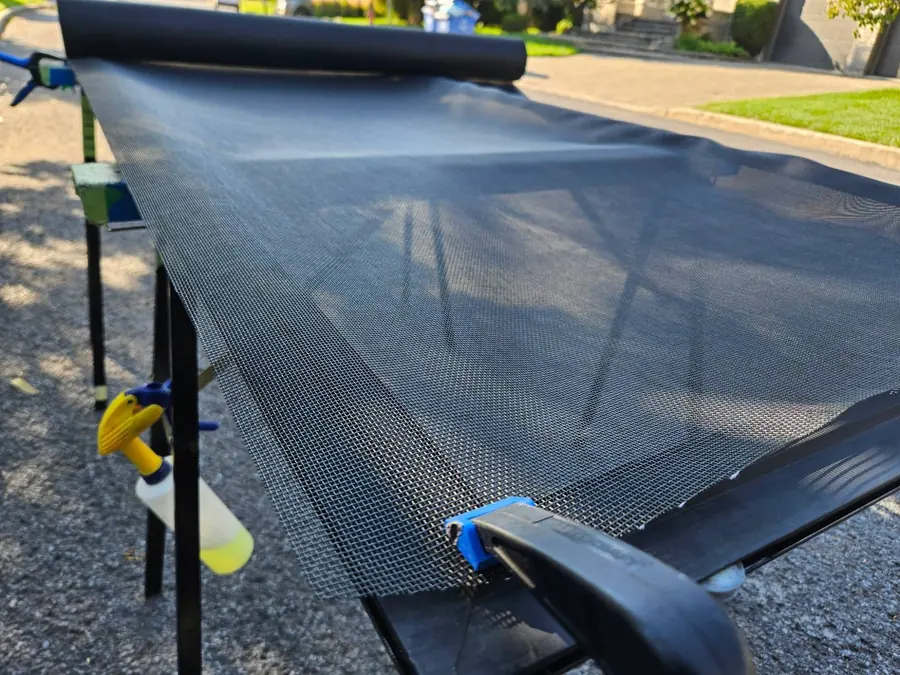
  7. Roll of new black mesh unrolled over a patio door frame, held by blue clamps7
    New mesh unrolled over the frame
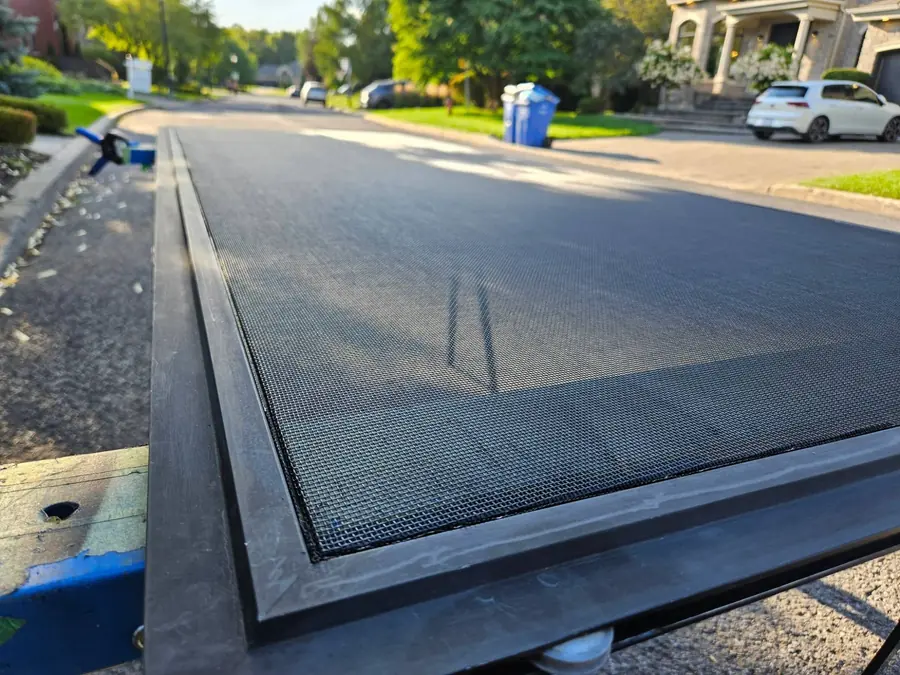
  8. Rescreened patio door, black mesh taut and spline in place, on trestles in the street8
    Done: mesh taut, spline in, frame straight
Job 2

A patio door frame built new

When the original frame is bent or split, it cannot be repaired: we build it new. Aluminum profile cut to the size of the opening, corner brackets, new rollers — all assembled on the trestles before the mesh goes in.

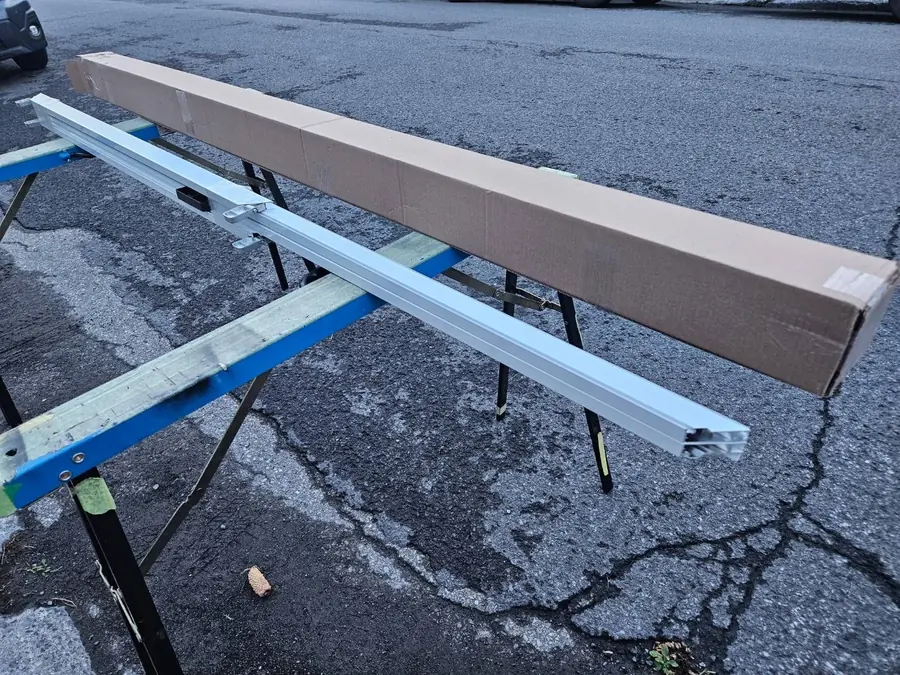
  1. Length of white aluminum patio door frame profile on trestles beside its cardboard box1
    The new aluminum profile, out of its box
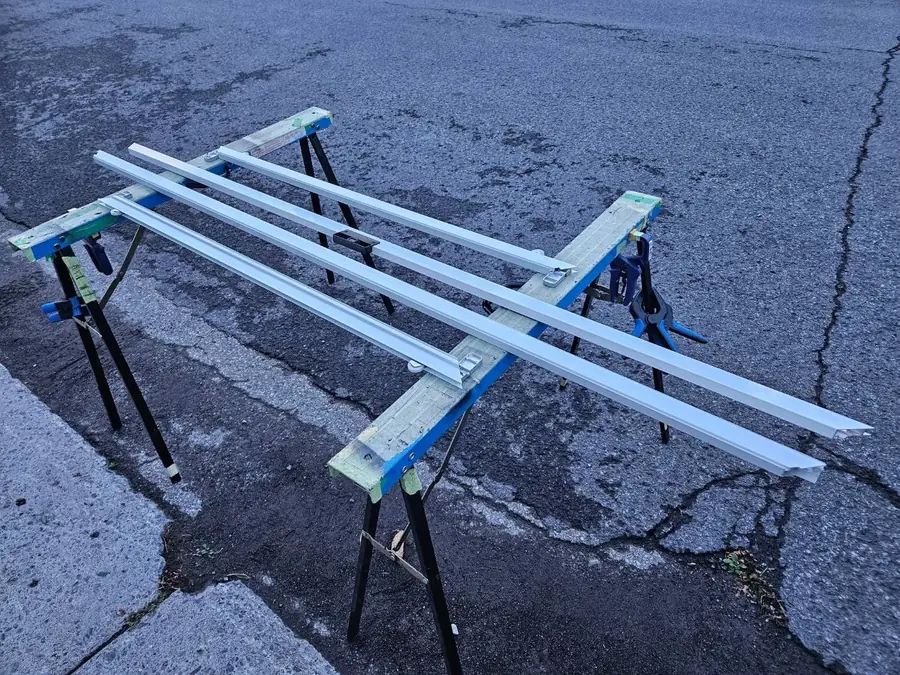
  2. Four cut lengths of white aluminum profile laid across two trestles2
    The four sides, cut to the size of the opening
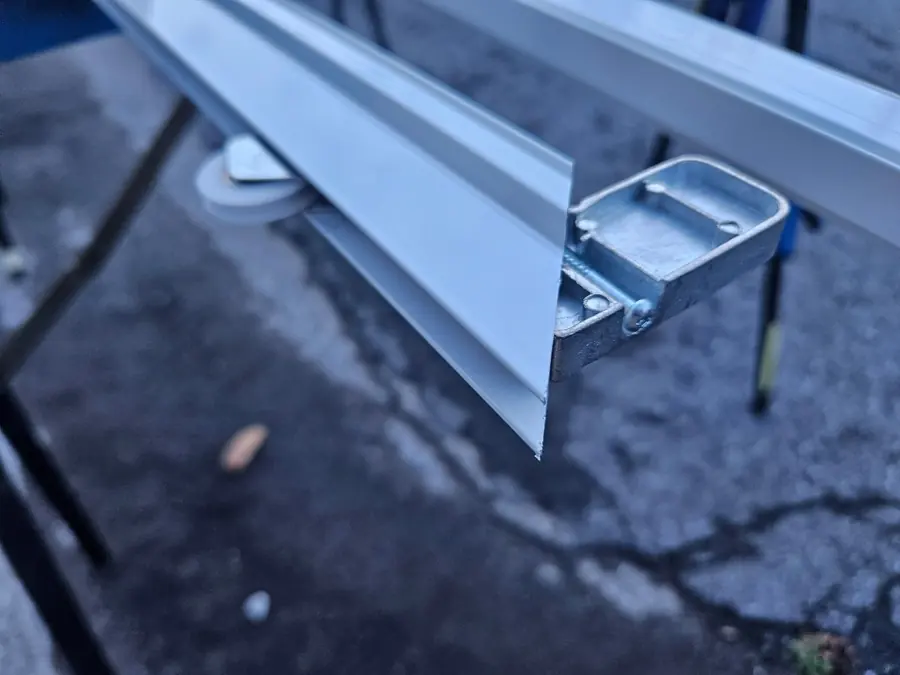
  3. Close-up of the metal corner bracket and roller of a new patio door frame3
    The corner bracket and the roller, before assembly
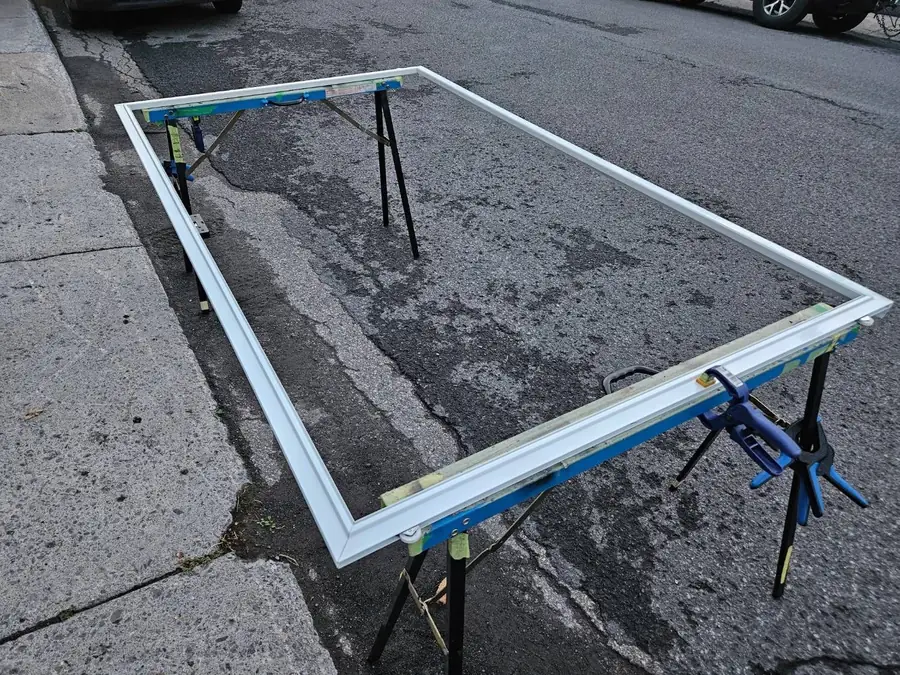
  4. New white patio door frame assembled, resting on two trestles in the street4
    The frame assembled, square, ready for its mesh

Moves that make it worse

What not to do

Avoid

Forcing a door that jumps the track

This is the move that turns a roller repair into a frame repair: the door binds, you push harder, the corner bends, and the frame never quite gets its shape back. A door that has come off its track is lifted, set back in place and used gently until the repair.

Avoid

Oiling the track with a greasy lubricant

Oil holds sand and pet hair: the track turns into a paste that jams the rollers faster than before. A track is cleaned dry, and lubricated with a dry product.

Avoid

Patching torn mesh with tape

Tape does not hold, discolours the mesh and leaves adhesive in the channel that new spline could do without. A hole in the mesh is the sign it has reached the end of its life; it gets replaced.

Avoid

Re-tensioning mesh without the right spline

Mesh set with spline that is too thin pops out at the first gust; spline that is too thick splits the frame’s channel. This job takes the right tool and the right diameter — not force.

Straight answers

Patio door questions

The questions we hear on the phone, and their answers.

Free quote438-466-4094
Does the door have to come off to be repaired, and how is that done?

Yes, every repair is done with the door off. A sliding screen door lifts into its top track to free the bottom rollers; on some models the rollers must first be retracted with their adjustment screw. We set it on trestles, repair it and put it back in front of you.

My door locks, but opens in the wind. Is it the handle?

Often the strike rather than the handle: it has worked loose, or the latch no longer reaches deep enough into it because the door has dropped on tired rollers. We set the door height first, then the hardware — in that order, or the adjustment will not hold.

Do you repair the screen on a three-panel patio door or a French door?

Yes. Screens on three-panel doors and on sliding French doors have the same parts — frame, mesh, spline, rollers — in different formats. What changes is the roller model and the track depth; we identify them on site.

My door’s mesh is intact, but mosquitoes get through. Why?

Three common causes: the mesh has gone slack and leaves a gap along the frame; the sealing brush on the stile — the pile weatherstrip — is worn; or the door, dropped on its rollers, no longer meets the frame at the top. Intact mesh does not make a tight door: the fit matters just as much.

My screen door is on the outside of the glass door. Is that normal?

Yes: on most patio doors the screen rides on the outer track and the glass door on the inner one. On some models it is the reverse. That changes how the door comes off and sometimes the roller model, not the repair.

Can I send you a photo before you come?

That is actually what we prefer. One photo of the whole door, one of the bottom with the rollers and one of the damaged corner tell us almost everything: mesh type, roller model, frame condition. The quote form accepts photos, and we prepare the parts before leaving.

Free quote

Tell us about your door

The type of door, what it does — jumps the track, drags, lets bugs in — and a photo if you have one. The form below is already set to patio door; we get back to you with a free quote.

Request a quote

Three minutes, and you have a price. No commitment.

No commitment · Quick reply · Work guaranteed 1 year

Near you

Patio door screens, city by city

Montérégie

See all areas