
Summer UV
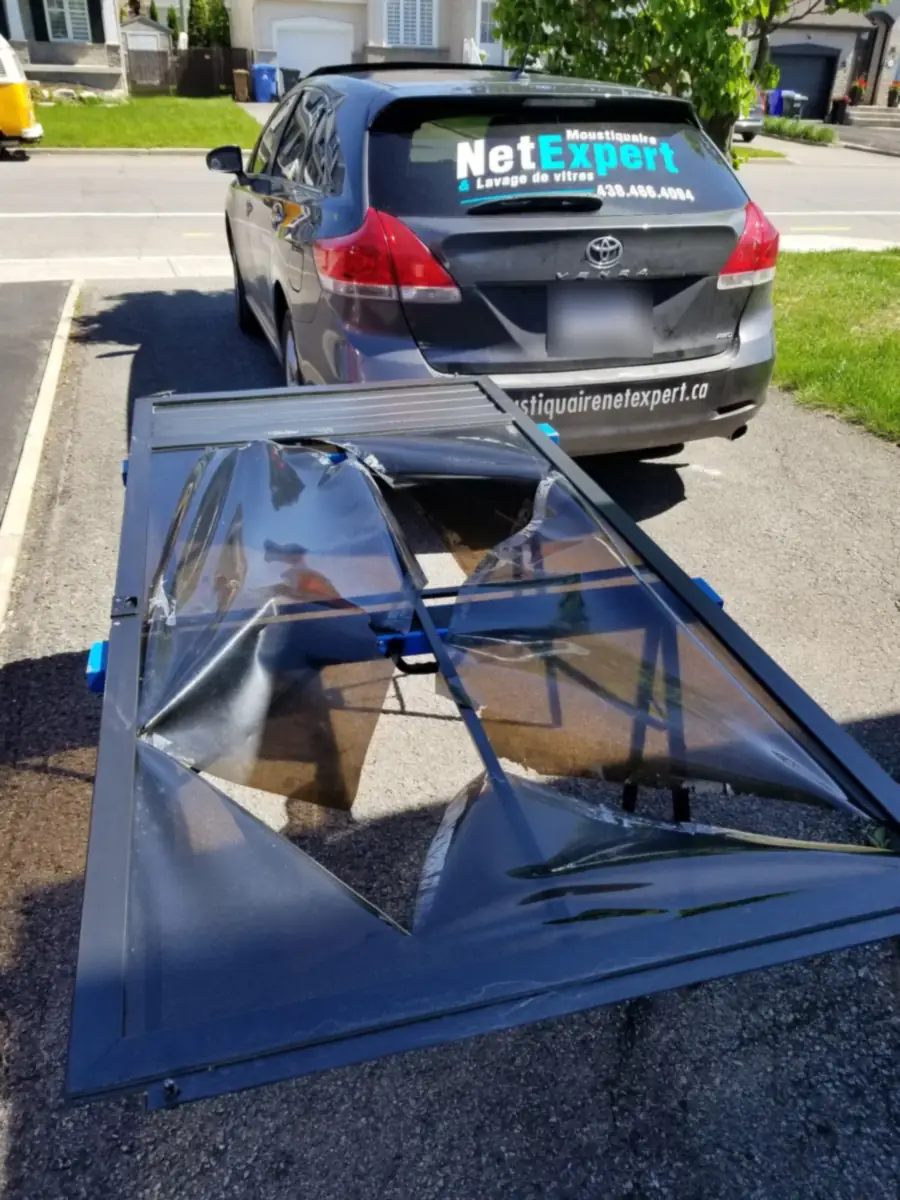
Sun yellows and clouds the vinyl. Film that crackles to the touch is at end of life.
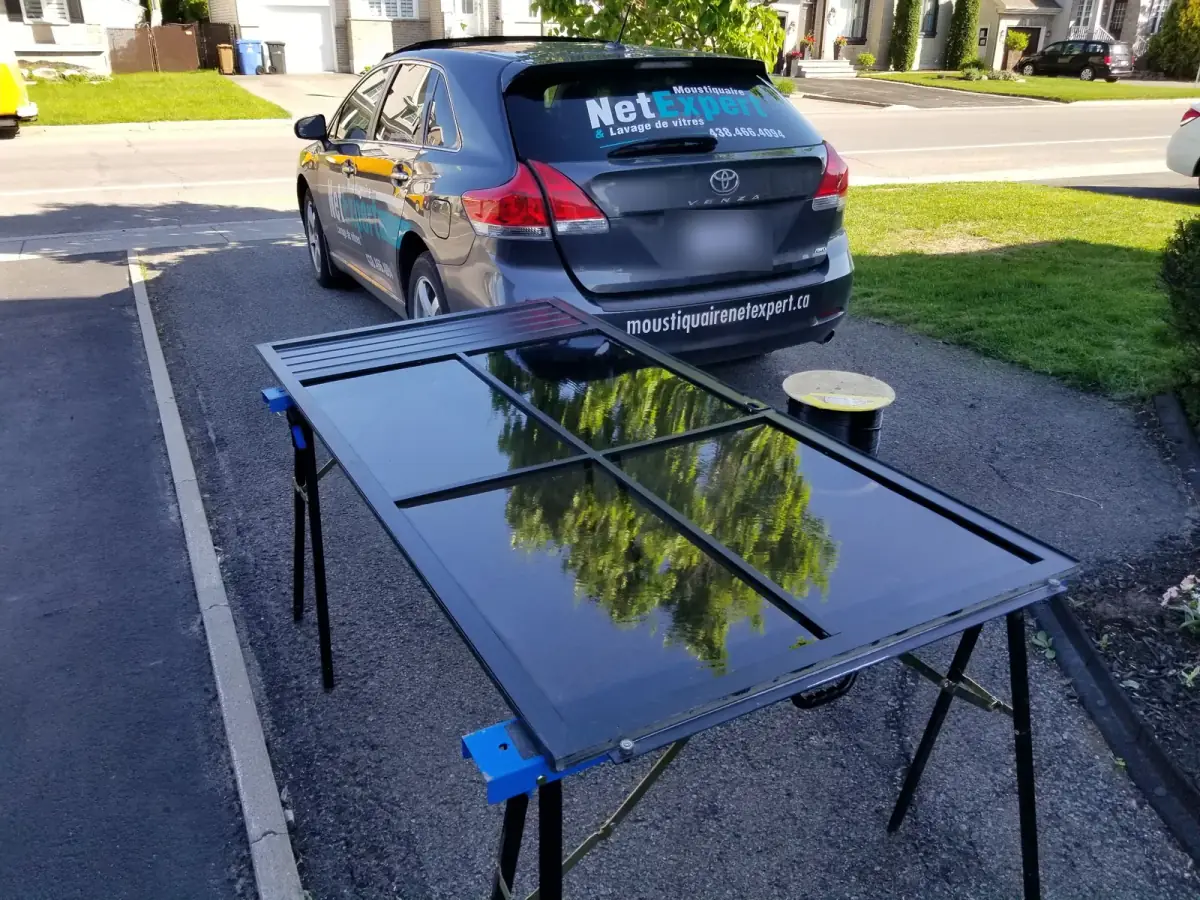
Gazebo and sun shelter specialty
Clear vinyl yellowed or torn? Replaced at your home in Dorval, in the original frames — gazebos and sun shelters.
Three questions are enough to start. The official measurement is taken on site.
Whatever your retailer calls it — MICA film, clear vinyl, clear plastic, sun-shelter transparent fabric — it is the same material, and we replace it in Dorval in your existing panels.
Sun yellows and clouds the vinyl. Film that crackles to the touch is at end of life.
Below freezing, MICA turns brittle — one handling or one gust splits it outright.
Slack vinyl flaps like a sail and eventually tears at the seams.
Dorval has two very different kinds of backyard, and therefore two kinds of gazebo. North of the railway, the post-war bungalows and cottages of the 1950s and 1960s sit on modest lots with a deck at ground level and, in many cases, a retail gazebo set near the fence: aluminum or steel frame, standard-format panels, original clear vinyl that has been through several winters. Along Lac Saint-Louis the picture changes entirely. Along Lac Saint-Louis, the resort-era houses have often had a carpenter-built wooden shelter added later, its openings cut by hand: the rails fall where the framing allowed, and two adjacent openings do not give the same figure.
That permanent structure is a different trade from the boxed gazebo. Its panels are held by wooden battens, screwed or nailed, rather than a spline in an aluminum groove; its openings follow the framing, not a catalogue; and the film is sometimes stapled on by the owner in the fall, slightly differently each year. Facing the lake, wind is in charge: film put up in a hurry snaps and tears with the first big gusts of autumn. North of the tracks, on retail gazebos, the logic is that of replacing material in a standard frame. Both are redone on site, but not the same way.
On a wooden structure by the water, rescreening means lifting the battens without breaking them, stripping the worn mesh or film, stretching the new material flat across the frame and refastening clean battens — the old ones have often dried out and split at the first screwdriver. Every opening is measured on its own, because framing exposed to the lake has moved since it was built. On the retail gazebo in the north end, the motion is different: the panel comes off the structure, the yellowed film or slack mesh comes out of its groove, a new spline holds the new mesh or clear vinyl (MICA film), and the panel goes back where it was. In both cases the structure — wood or metal — is left alone.
The first challenge is recognizing which family you are dealing with; the second is the ground. On the shore of Lac Saint-Louis, a permanent structure may sit at the bottom of a slope toward the water, on a wooden deck, and its panels can be tall and heavy: two people take them down, and they are redone flat in the mobile workshop parked in the driveway. On the bungalow streets north of the tracks, the yard is small and the gazebo is often pushed against the fence: you work in little space, but at grade and with no dimensional surprises.
The lake does two things to a gazebo: it sends wind and it bounces light. On faces turned toward the water, the film ages faster, because it takes direct sun plus its reflection off the surface, then beats in the gusts until it splits. There, the film goes on early in the fall, pulled tight, starting with the faces that give onto the water: those split first, and doing them first avoids opening the same gazebo twice. North of the railway the same film lasts longer: the yard is small, the fence and the next house break the gust before it reaches the gazebo, and it is the sun, not the wind, that decides its age. In the enclosed yards to the north, standard fibreglass is enough.
Prefer English? We serve you in whichever language you choose, in Dorval as everywhere else.
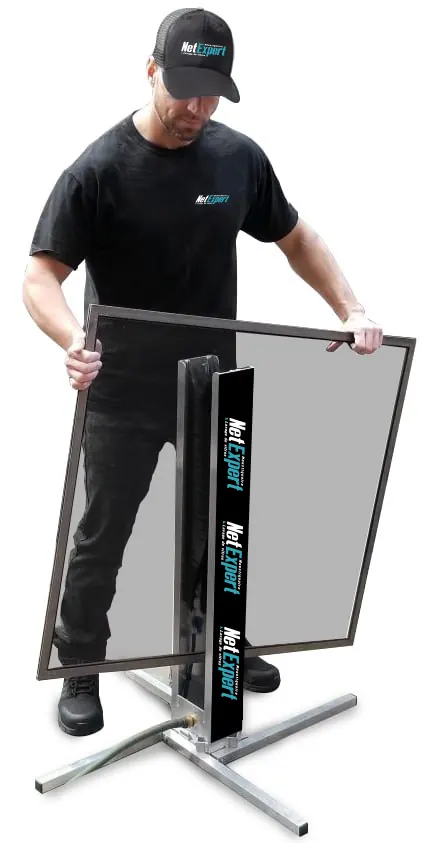
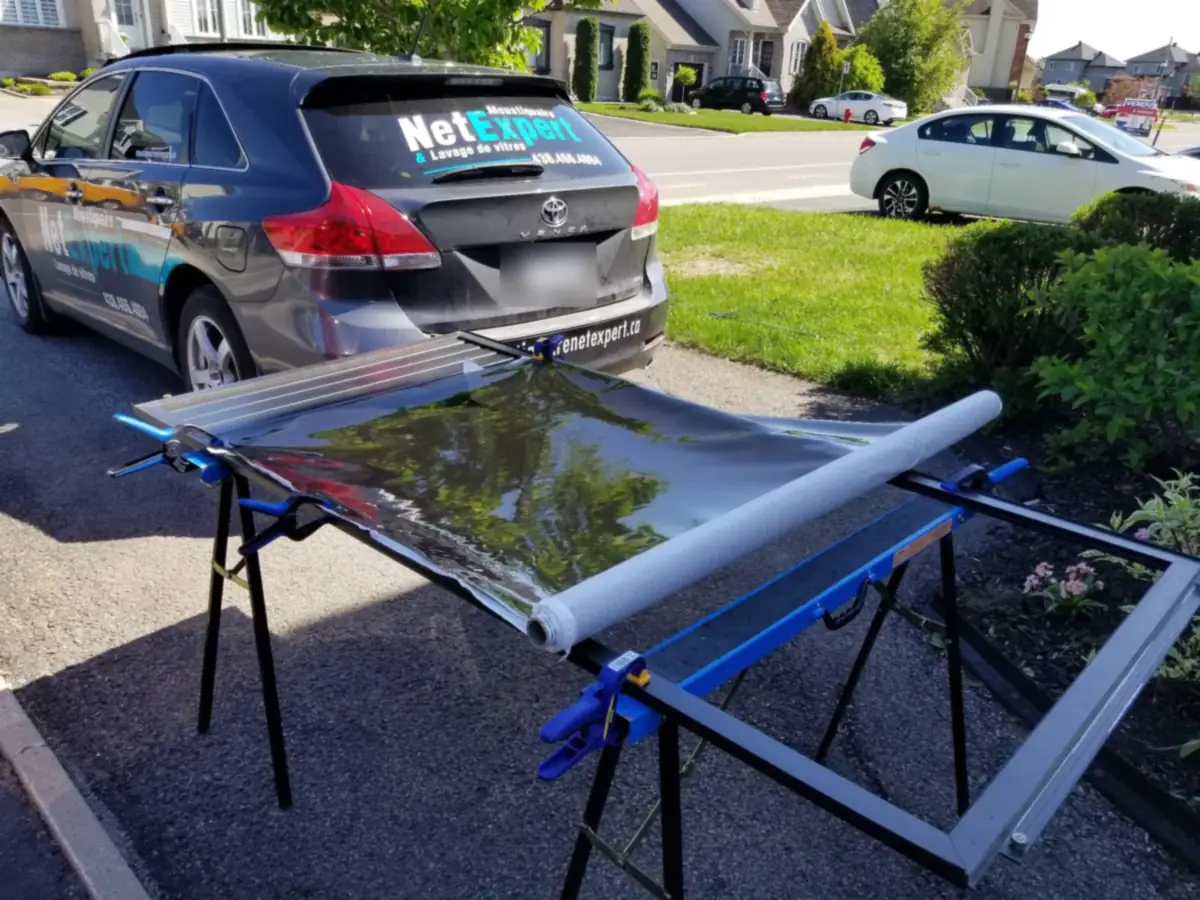
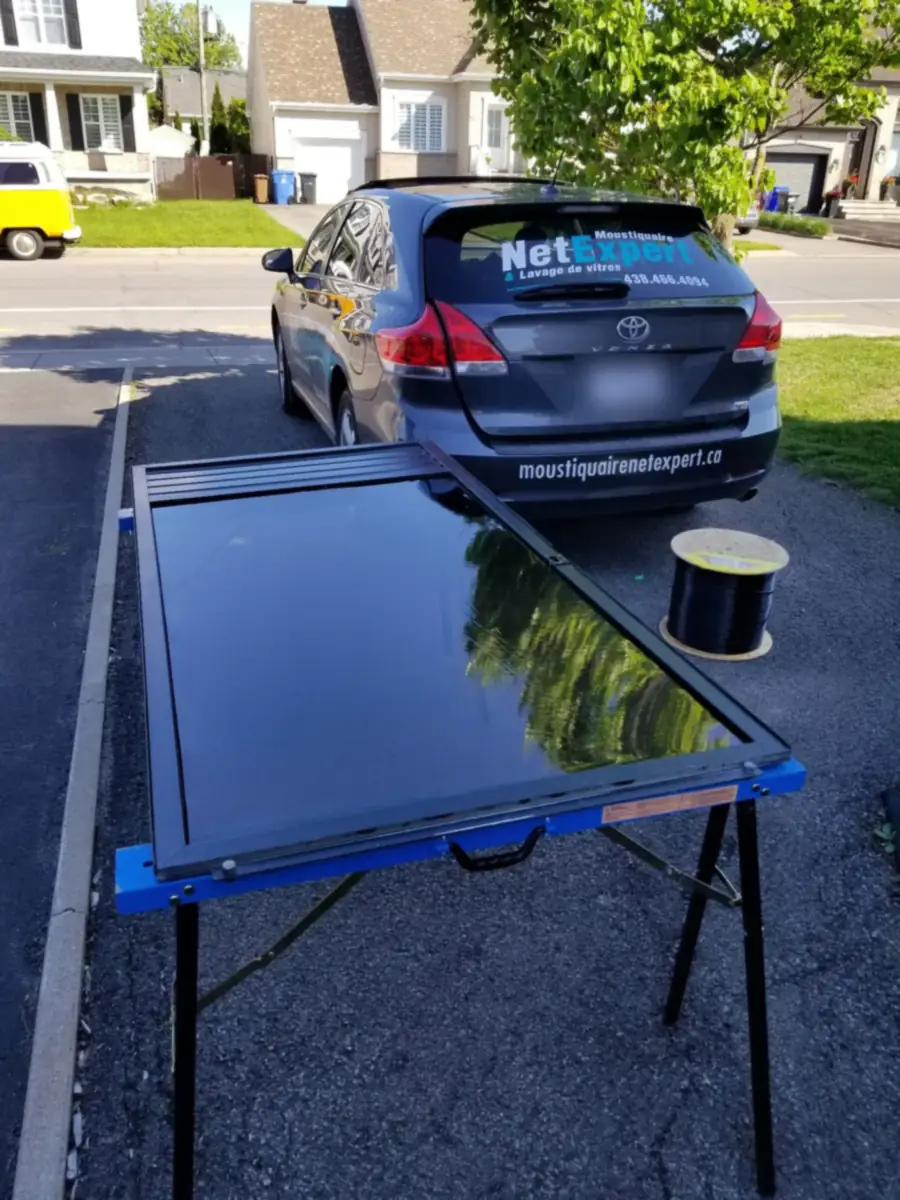
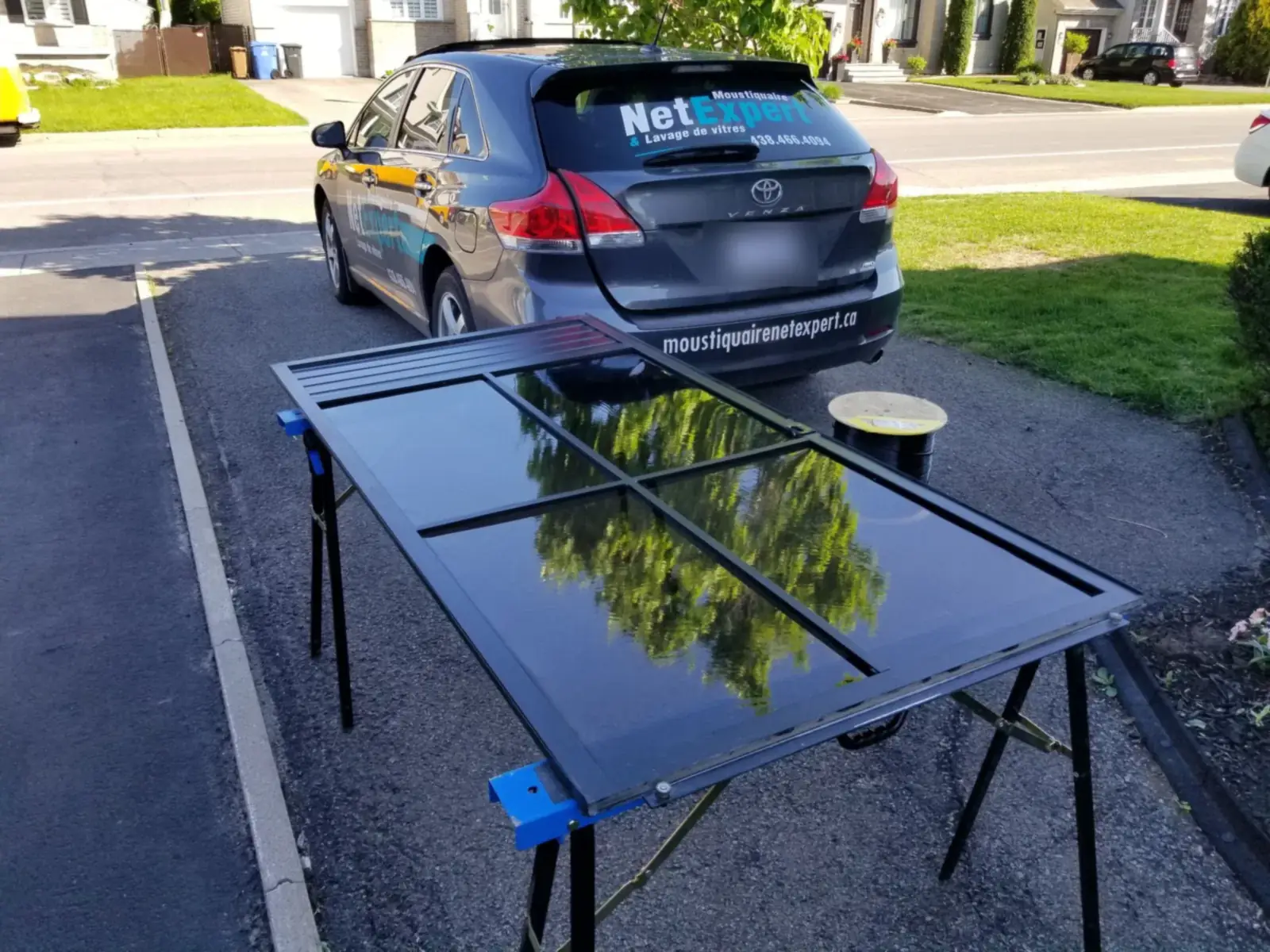
This job was not in Dorval — it shows our method, the same everywhere: panels down, new vinyl pane by pane, panels back up.
« Great service! He was at my neighbour’s and agreed to fix my back screen even though we had no appointment. Very successful repair, and inexpensive! »
« Ludovic replaced my screen in record time. Professional, and with a great sense of humour. I recommend his services — don’t hesitate to contact him, he’ll come to your home and do beautiful work. »
« Excellent service. Clear explanations of the work to be done. I really appreciated his dedication: despite the rain he insisted on finishing the job, soaked through and still smiling. The work was very well done. »
Straight answers
Yes. On a permanent structure built to measure, no drawing would help anyway: we measure each opening on site, one at a time, as the battens come off. Mesh or film is cut to those dimensions and stretched in the original frame. Dried or split battens are replaced with new ones, and the framing stays exactly as it is.
Often, yes. Film that snaps is film that is loose, or fixed to a frame with play in it: stapled by hand, it keeps folds, and the wind works in the folds. Cut to exact size and held around its whole perimeter in the panel frame, it beats far less. On the most exposed faces, aluminum screen mesh holds up better through winter than film left in place.
No. The panels of a retail gazebo release from inside the structure, without anyone squeezing behind it. They are then redone in the mobile workshop and put back one at a time. Tight quarters slow the handling a little on the fence side, but nothing in the structure itself moves or comes apart.
Yes, at your home. We travel to Dorval, remove the panels, replace the MICA vinyl in the original frames and put everything back — the gazebo structure is never touched. It is one of our specialties.
Yes. Depending on the retailer it is called MICA film, clear vinyl, clear plastic or transparent fabric — the same flexible material that cuts wind and holds warmth. We replace it on gazebos and sun shelters alike.
Yes. The vinyl is replaced pane by pane, in the existing frame — no need to redo the whole panel for one tear. If several panes have yellowed, doing them together gives a uniform result.
On assessment: the price depends on the number of panels and their dimensions. The quote is free, and a photo is often enough to price without a visit. Fabrication and installation guaranteed one year.
Do you manage a building or a business in Dorval?