
Summer UV
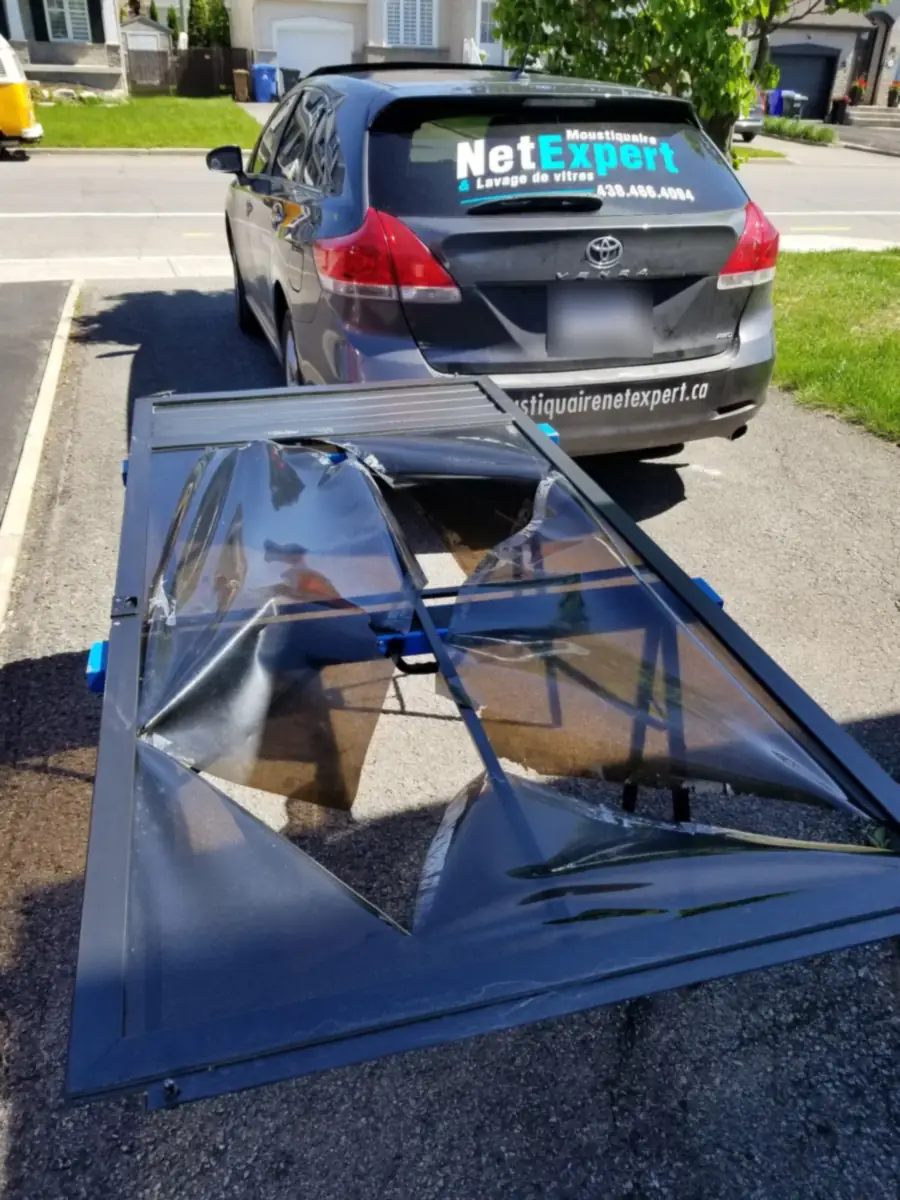
Sun yellows and clouds the vinyl. Film that crackles to the touch is at end of life.
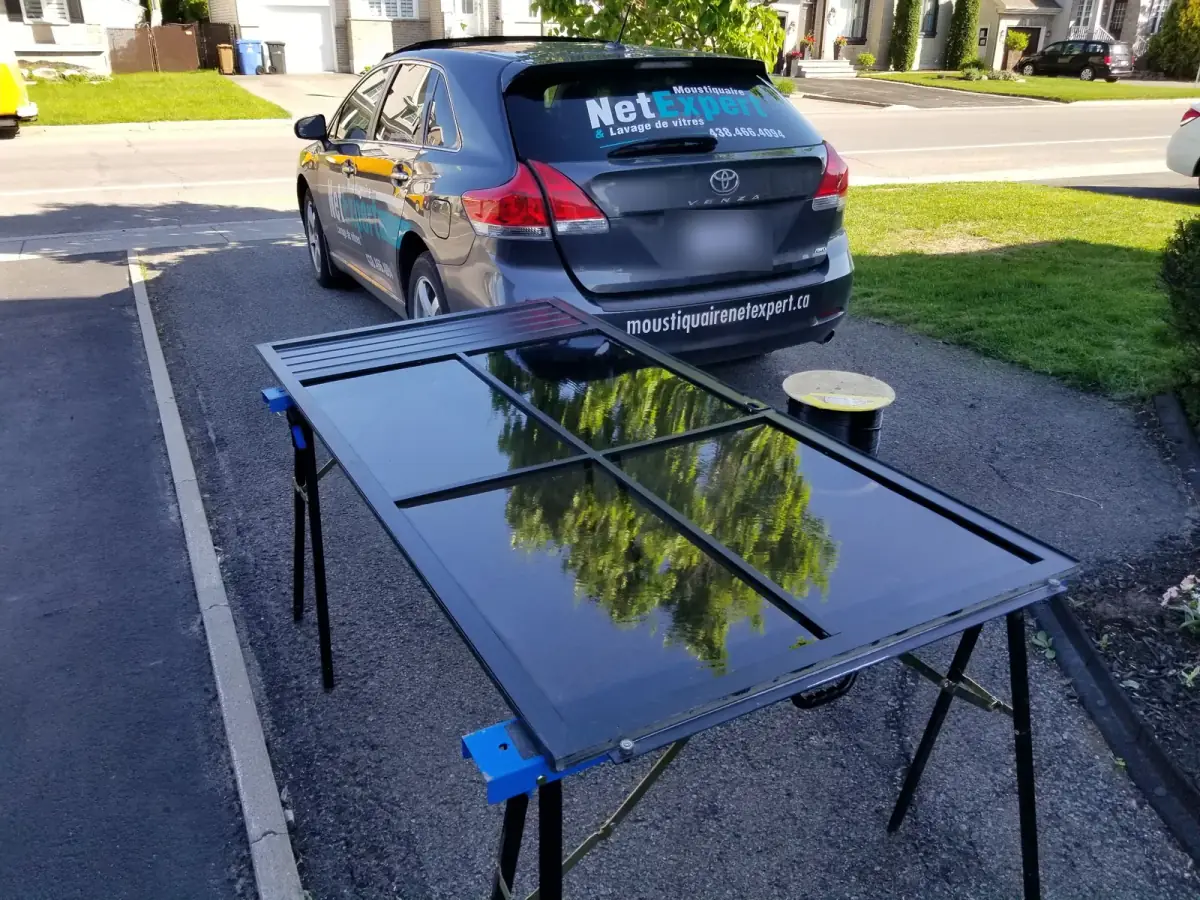
Gazebo and sun shelter specialty
Clear vinyl yellowed or torn? Replaced at your home in Sainte-Julie, in the original frames — gazebos and sun shelters.
Three questions are enough to start. The official measurement is taken on site.
Whatever your retailer calls it — MICA film, clear vinyl, clear plastic, sun-shelter transparent fabric — it is the same material, and we replace it in Sainte-Julie in your existing panels.
Sun yellows and clouds the vinyl. Film that crackles to the touch is at end of life.
Below freezing, MICA turns brittle — one handling or one gust splits it outright.
Slack vinyl flaps like a sail and eventually tears at the seams.
Sainte-Julie is backyard country. The two-storey detached homes and bungalows built between 1975 and 2005 sit on large lots, and the nearly universal patio door opens onto a wooden deck or a slab where the gazebo naturally finds its place. In the great majority of cases it is a retail gazebo: an aluminum or steel frame, a hard or fabric roof, and a set of standard-size screen panels rounded out by clear vinyl (MICA film) to stretch the season. On a large lot the gazebo is often bigger than in a city yard — six or eight panels instead of four — and that is as many panes of vinyl and screening to redo once age sets in.
Sainte-Julie lots also have room for a pool or a hot tub, and that is where the permanent structure appears: a custom-built wooden gazebo beside the water, with one-of-a-kind panels, screens set in wooden frames and clear vinyl added in the fall to close in the hot tub shelter. These structures are as old as the house they belong to, and so are their panels: in the earliest subdivisions the original vinyl is long past its time. On any one gazebo every pane is the same age: the one that has split usually tells you the state of the rest.
On the retail gazebos in Sainte-Julie yards, the clear vinyl is the first to need work: the sun of a wide-open lot yellows it, frost stiffens it, and a late-autumn wind splits it along a fastener or a fold. The screen panels age next — slackened fibreglass mesh slapping in its frame, a corner torn right beside the patio door where everyone passes, spline riding up out of its groove. On a six- or eight-panel gazebo the vinyl is recut pane by pane in its original frame and every screen panel goes back with new spline — the size of the job is the pane count, not the difficulty. On a wooden structure beside a pool the principle is the same, but every panel gets measured, because none of them matches a catalogue size.
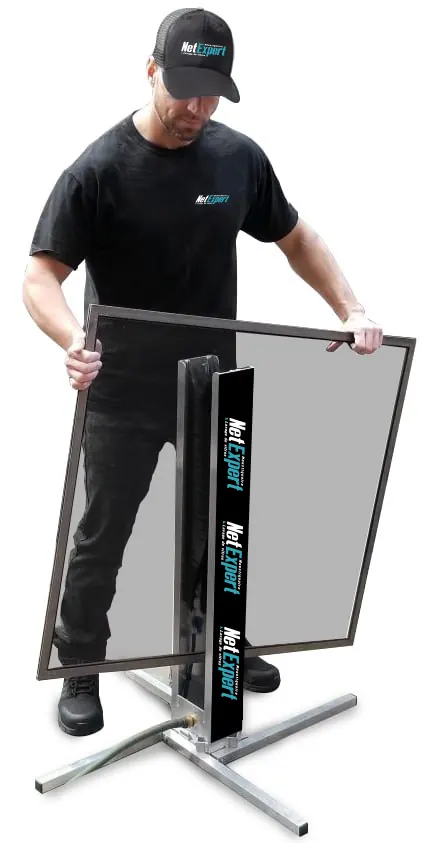
A retail gazebo comes apart by panel: each one unclips or unscrews, is rebuilt in the mobile workshop parked in the driveway, and goes back where it came from. On Sainte-Julie’s large lots, getting to the yard is rarely an issue — the side of the house is clear and the deck sits at grade or a step or two up. A wooden structure beside a pool takes more care: its panels are screwed or nailed, the floor can be slippery, and the pool fence stays closed while we work. On both types the structure is never altered. Counting the split panes before the visit lets us arrive with the right amount of vinyl.
A large suburban lot is an open lot. With no neighbouring building to break the wind, a gazebo in the middle of a Sainte-Julie yard takes gusts from every side, and clear vinyl that is not properly tensioned in its frame flaps until it splits — tension and fastening matter as much as thickness. Sun is the other factor: few mature trees in the newest subdivisions, so direct light yellows vinyl and weakens fibreglass; aluminum holds up better on the south-facing sides. A gazebo set at the far end of a large lot, away from the house, draws more insects than a deck against the wall: it is where it sits, not the address, that decides the weave. The vinyl goes on before the first frost.
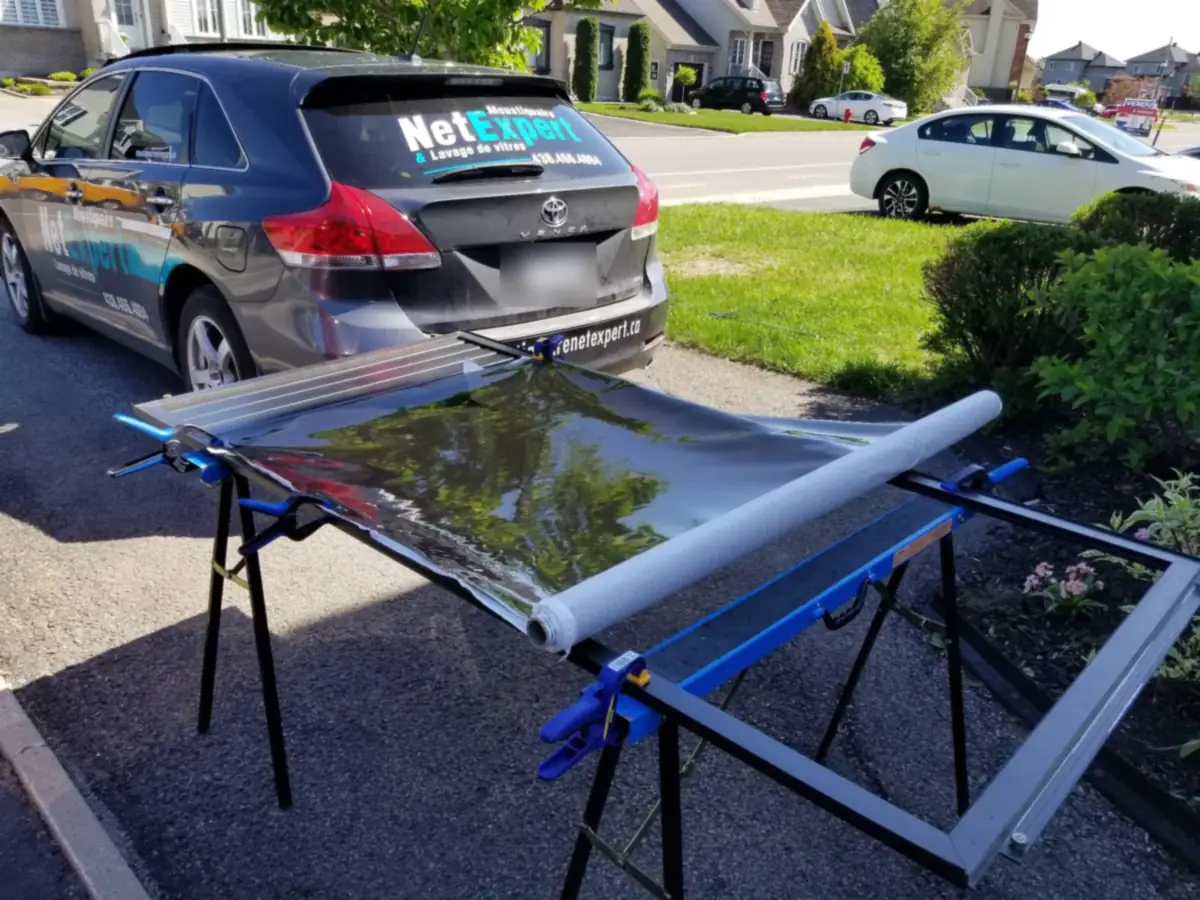
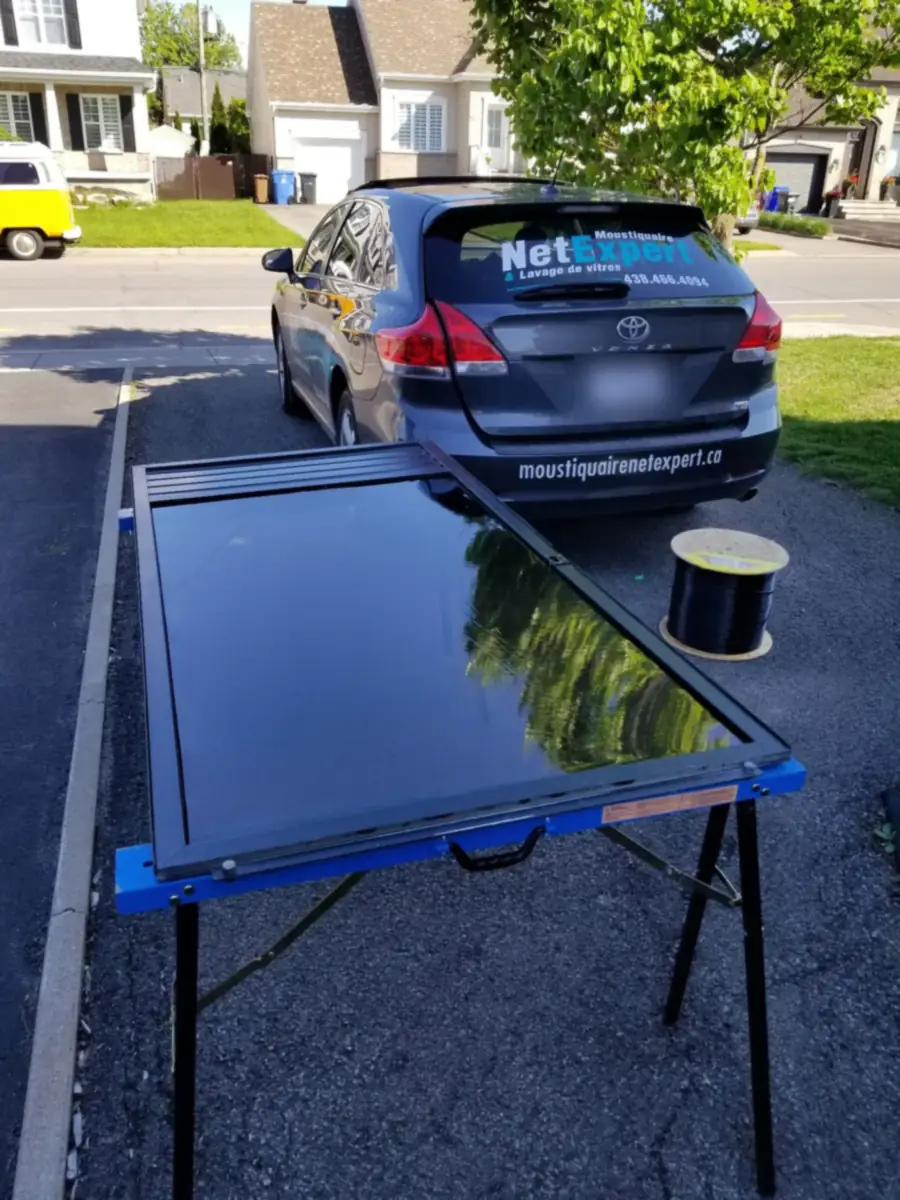
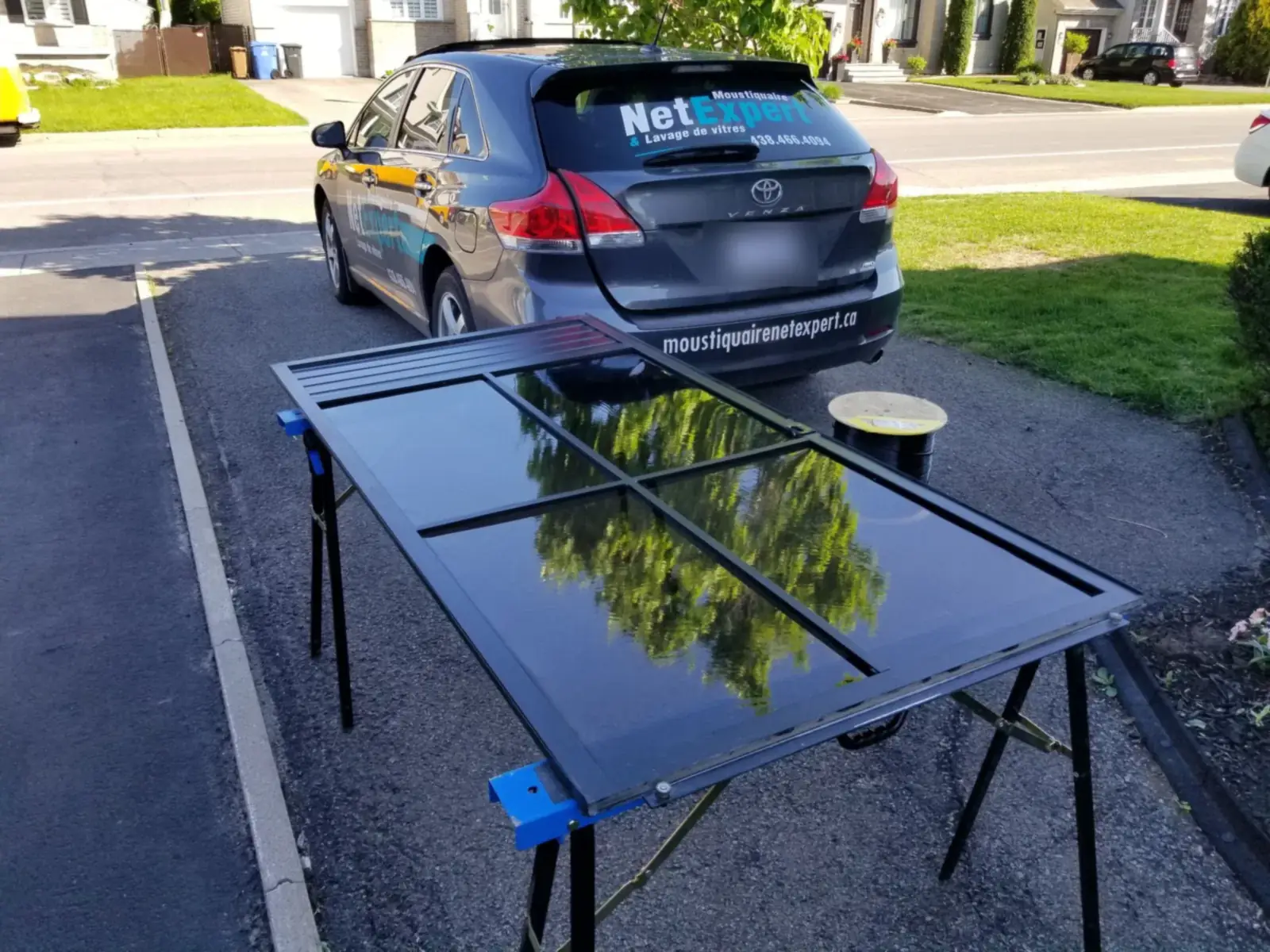
This job was not in Sainte-Julie — it shows our method, the same everywhere: panels down, new vinyl pane by pane, panels back up.
« Ludovic replaced my screen in record time. Professional, and with a great sense of humour. I recommend his services — don’t hesitate to contact him, he’ll come to your home and do beautiful work. »
« Excellent service. Clear explanations of the work to be done. I really appreciated his dedication: despite the rain he insisted on finishing the job, soaked through and still smiling. The work was very well done. »
« Great service! He was at my neighbour’s and agreed to fix my back screen even though we had no appointment. Very successful repair, and inexpensive! »
Straight answers
Yes. Clear vinyl is replaced to the exact size of each opening in the frames of the existing structure, and that is precisely its job: cutting the wind around the hot tub once screen season is over. On a custom wooden structure every panel is measured on site. Steam from the tub does not harm the vinyl; sun and frost are what wear it out.
No. Each pane of vinyl and each screen panel is handled separately in its own frame: we redo the ones that are split, torn or slack and leave the others. What is worth doing is a close look at the remaining six during the visit — on a gazebo whose panels are all the same age, the ones that look fine have often already yellowed or stiffened.
No. As long as the aluminum or steel frame is straight and the panel frames are not bent, the screening and the vinyl are rebuilt to the frame’s measurements without any manufacturer parts. It is common in neighbourhoods built twenty or thirty years ago: the model has vanished from the catalogue, but the gazebo itself is still solid. A bent frame is straightened or replaced piece by piece.
Yes, at your home. We travel to Sainte-Julie, remove the panels, replace the MICA vinyl in the original frames and put everything back — the gazebo structure is never touched. It is one of our specialties.
Yes. Depending on the retailer it is called MICA film, clear vinyl, clear plastic or transparent fabric — the same flexible material that cuts wind and holds warmth. We replace it on gazebos and sun shelters alike.
Yes. The vinyl is replaced pane by pane, in the existing frame — no need to redo the whole panel for one tear. If several panes have yellowed, doing them together gives a uniform result.
On assessment: the price depends on the number of panels and their dimensions. The quote is free, and a photo is often enough to price without a visit. Fabrication and installation guaranteed one year.
Do you manage a building or a business in Sainte-Julie?