
Summer UV
Sun yellows and clouds the vinyl. Film that crackles to the touch is at end of life.
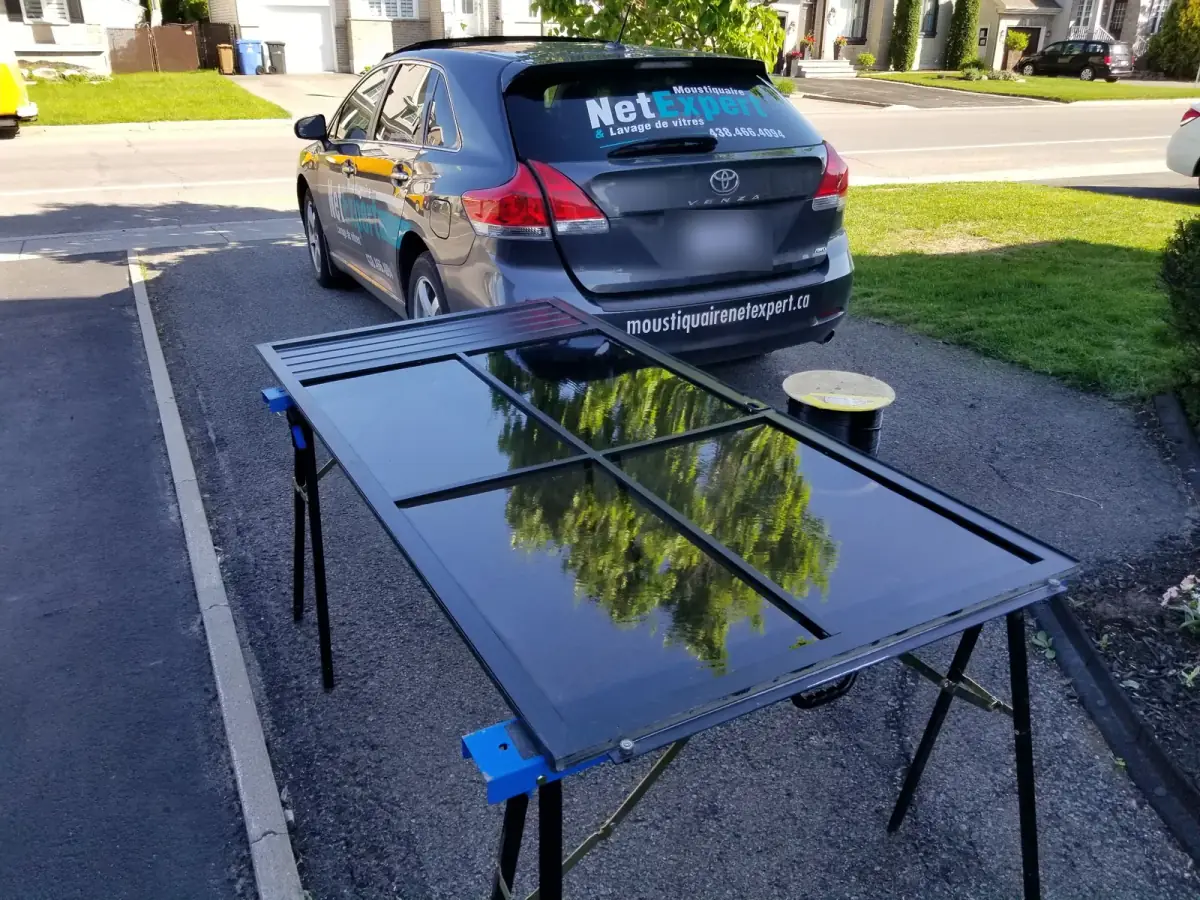
Gazebo and sun shelter specialty
Clear vinyl yellowed or torn? Replaced at your home in Saint-Rémi, in the original frames — gazebos and sun shelters.
Three questions are enough to start. The official measurement is taken on site.
Whatever your retailer calls it — MICA film, clear vinyl, clear plastic, sun-shelter transparent fabric — it is the same material, and we replace it in Saint-Rémi in your existing panels.
Sun yellows and clouds the vinyl. Film that crackles to the touch is at end of life.
Below freezing, MICA turns brittle — one handling or one gust splits it outright.
Slack vinyl flaps like a sail and eventually tears at the seams.
Saint-Rémi reads as three eras of back yard, and the gazebo is not the same in any of them. The old village has older houses on enclosed lots, where the gazebo is a late addition, often in the shade of mature trees. The 1960s-to-1980s bungalows are the real territory of the retailer gazebo: an open back yard, a slab or wooden deck already in place, an aluminum or steel frame with standard-size panels, up long enough that the original film has run its course. In the recent semi-detached developments the same model returns in a smaller size, in a narrow yard with no shade.
What ties all three together is the black earth surrounding the town. Worked market-garden soil is light soil: wind lifts it, and the fine dust travels right into the yards. On a screen panel it settles into the mesh; on clear vinyl it spreads as a haze and calls for frequent cleaning, which has direct consequences for how long the vinyl lasts. Bungalow yards on the outskirts, open to the fields, also take the wind with no windbreak at all, while the old village yards, ringed by buildings and trees, get far less of it.
On a retailer gazebo out on the edge of town, the film accumulates both local forms of wear. The fine dust acts as an abrasive: every pass of a cloth leaves a web of scratches, and the vinyl turns milky before it has even yellowed. Wind off the fields does the rest, flapping the panes until a crease gives way, usually along an edge. The screening fouls first — loaded mesh cuts airflow and gives the impression a panel no longer breathes — then slackens, tears at a corner, or lets its spline work loose. We redo the film pane by pane to dimensions measured on site, rescreen the panels in their original frames, and the gazebo structure is never taken apart.
Access varies from one era to the next, and that is what decides how we work. A bungalow yard opens through a wide side driveway: panels come out easily, one at a time, to the mobile workshop. In a recent semi, the corridor between two houses narrows to a gate, and the route gets checked before anything starts. In the old village the yard is enclosed and the passage narrower still. The principle does not change: one panel at a time, never the whole structure, and on a gazebo whose panels match no size sold anywhere, each opening is measured separately.
Out along the fields the drainage ditches stay wet and the evening shows it: on the faces where you actually sit, a tight weave stops what ordinary mesh lets through. Wind decides the rest of the choice: on a yard open to the fields, fibreglass ends up bagging out while aluminum mesh stays flat. And because dust is constant here, the film goes on before the first cold snaps and goes on tight: a properly tensioned pane cleans without broad scrubbing, so it scratches less.
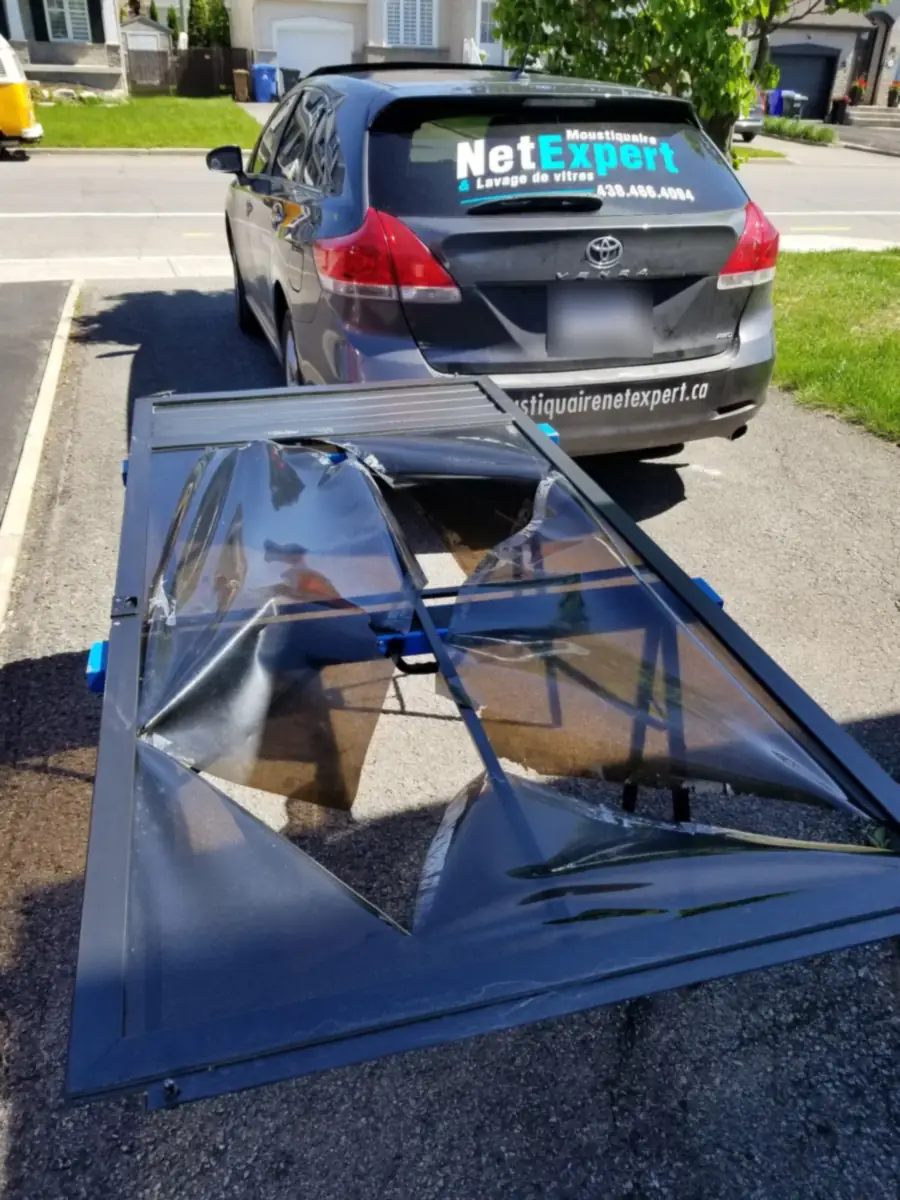
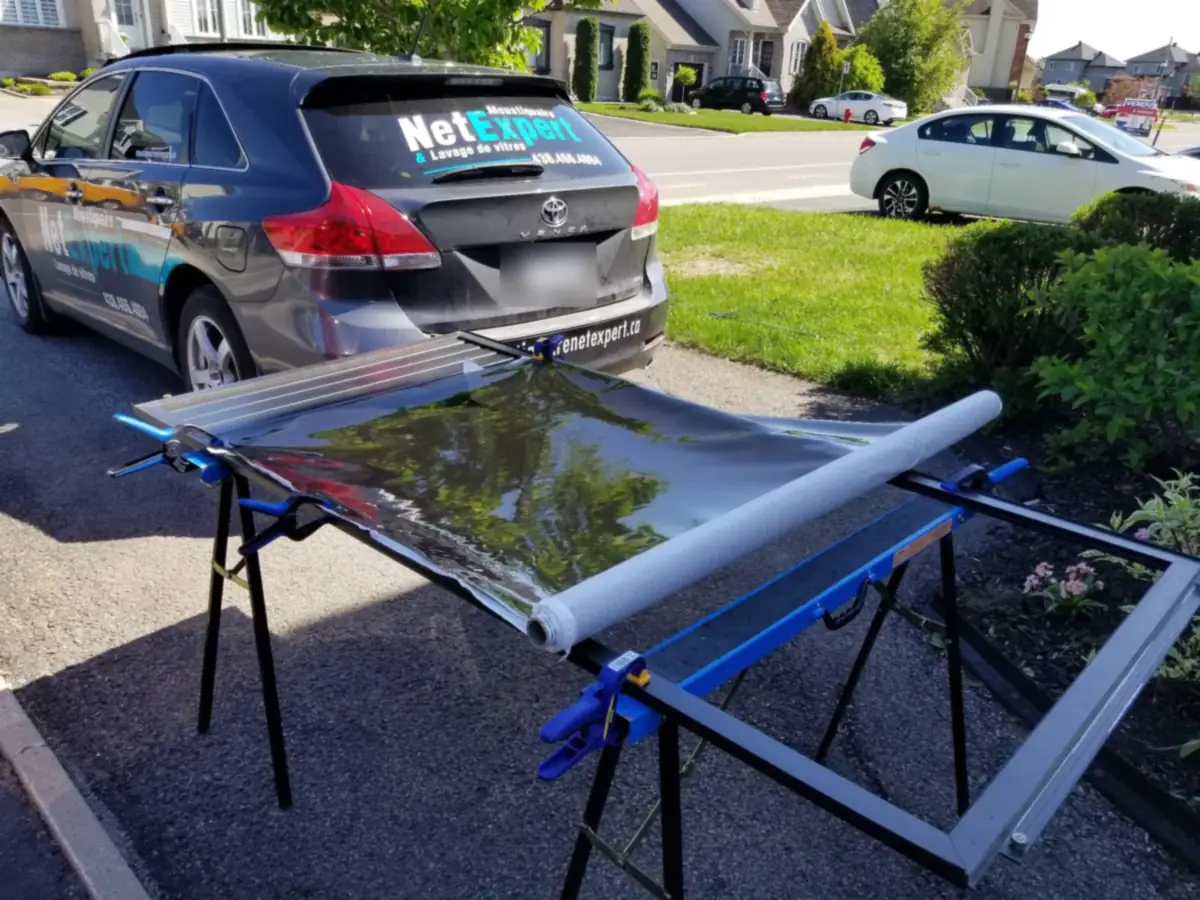
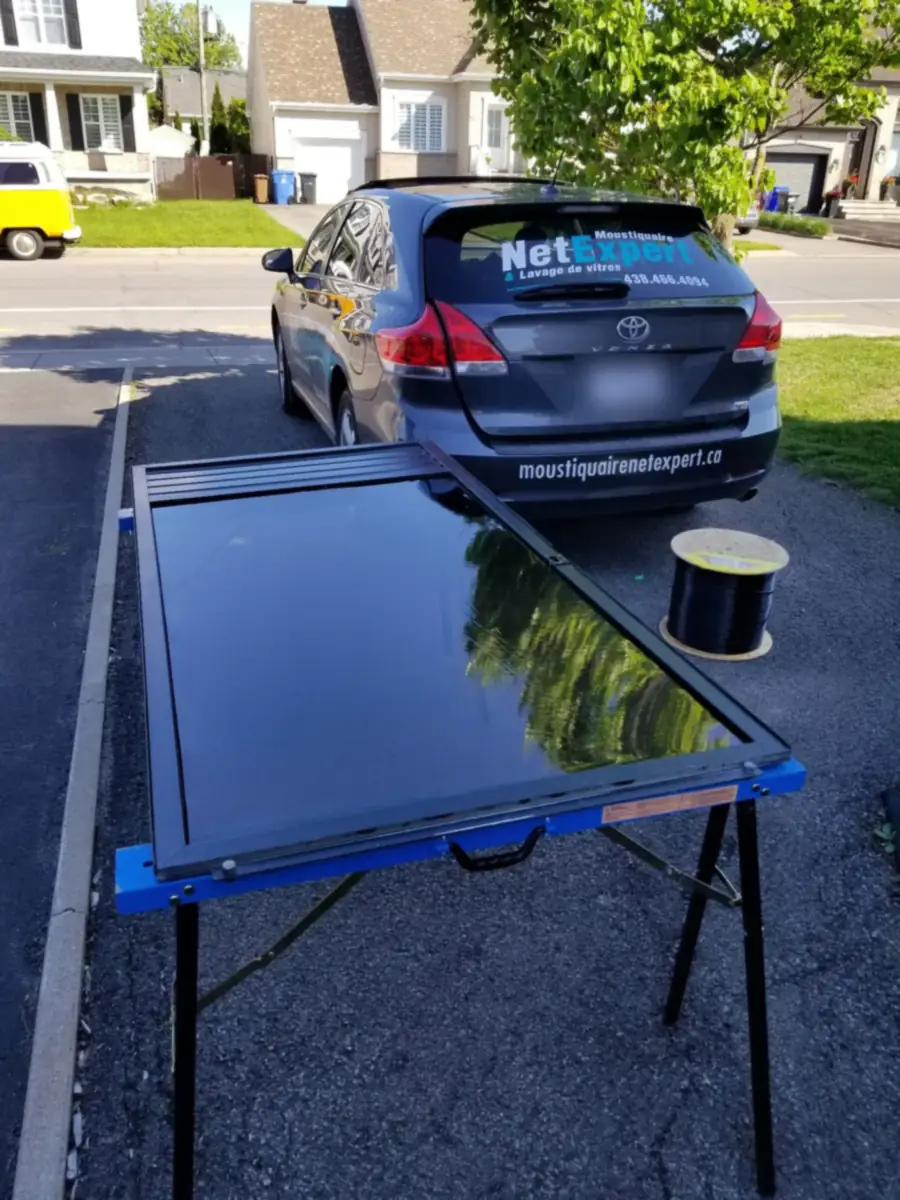
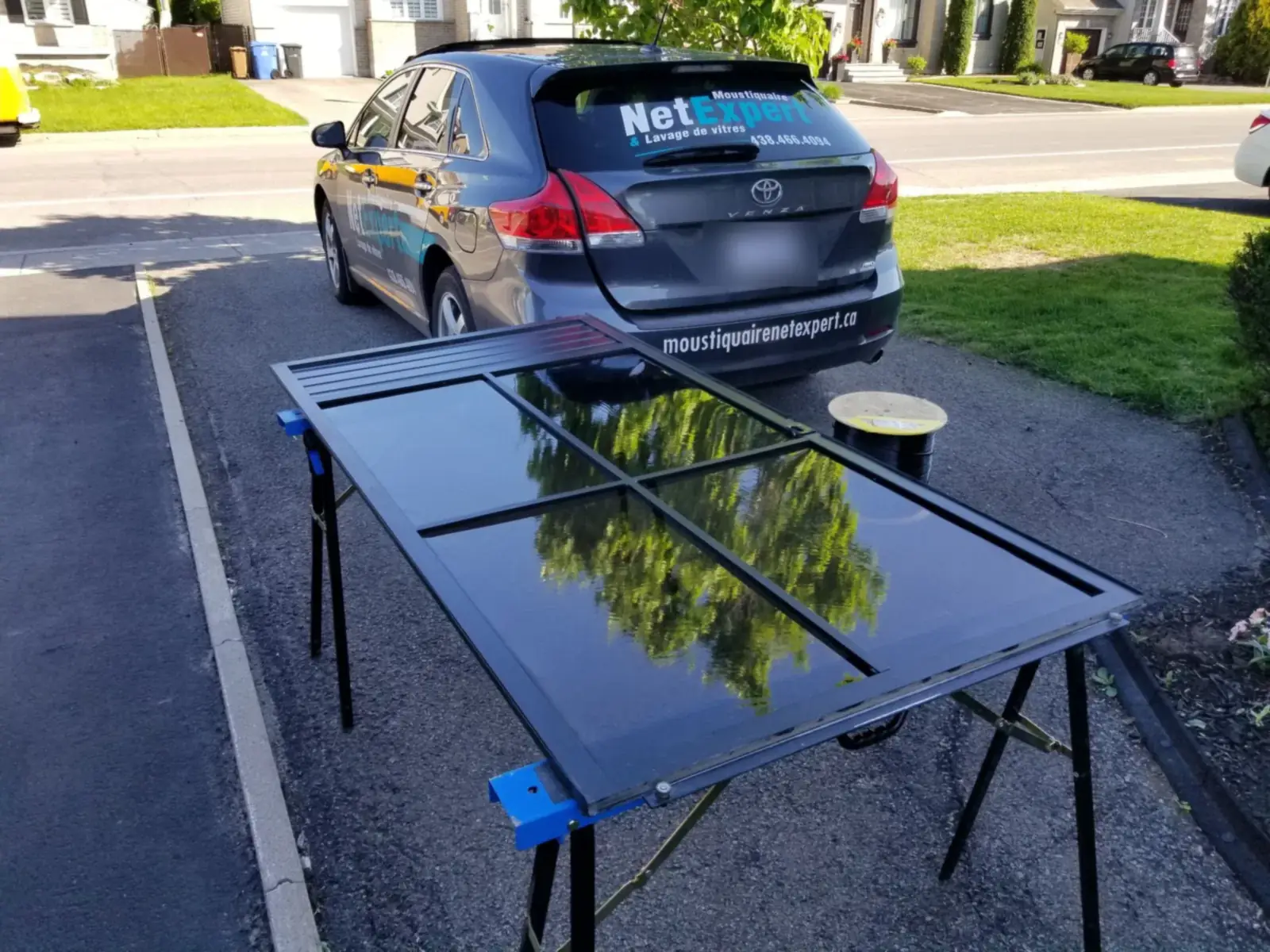
This job was not in Saint-Rémi — it shows our method, the same everywhere: panels down, new vinyl pane by pane, panels back up.
« Excellent service. Clear explanations of the work to be done. I really appreciated his dedication: despite the rain he insisted on finishing the job, soaked through and still smiling. The work was very well done. »
« Great service! He was at my neighbour’s and agreed to fix my back screen even though we had no appointment. Very successful repair, and inexpensive! »
« Ludovic replaced my screen in record time. Professional, and with a great sense of humour. I recommend his services — don’t hesitate to contact him, he’ll come to your home and do beautiful work. »
Straight answers
Dust from the surrounding fields is fine and abrasive. Every cleaning drags it across the vinyl and leaves micro-scratches; over time they scatter light and the pane never comes back clear, clean or not. At that point the vinyl is finished: the film is replaced pane by pane in the original frame.
Usually yes, once the mesh has been loading with dust for several seasons. Deeply fouled mesh does not rinse out: the particles are caught in the weave itself. The panel is rescreened in its frame, and that is the moment to pick a mesh suited to how that face of the gazebo is exposed.
Generally yes, because it is the film and the mesh that wear out, not the frames. A straight aluminum frame whose channel still grips the spline is redone without trouble. What we look at on site is the condition of the frames and the structure; everything else is replaced within what is already there.
Yes, at your home. We travel to Saint-Rémi, remove the panels, replace the MICA vinyl in the original frames and put everything back — the gazebo structure is never touched. It is one of our specialties.
Yes. Depending on the retailer it is called MICA film, clear vinyl, clear plastic or transparent fabric — the same flexible material that cuts wind and holds warmth. We replace it on gazebos and sun shelters alike.
Yes. The vinyl is replaced pane by pane, in the existing frame — no need to redo the whole panel for one tear. If several panes have yellowed, doing them together gives a uniform result.
On assessment: the price depends on the number of panels and their dimensions. The quote is free, and a photo is often enough to price without a visit. Fabrication and installation guaranteed one year.
Do you manage a building or a business in Saint-Rémi?