
Summer UV
Sun yellows and clouds the vinyl. Film that crackles to the touch is at end of life.
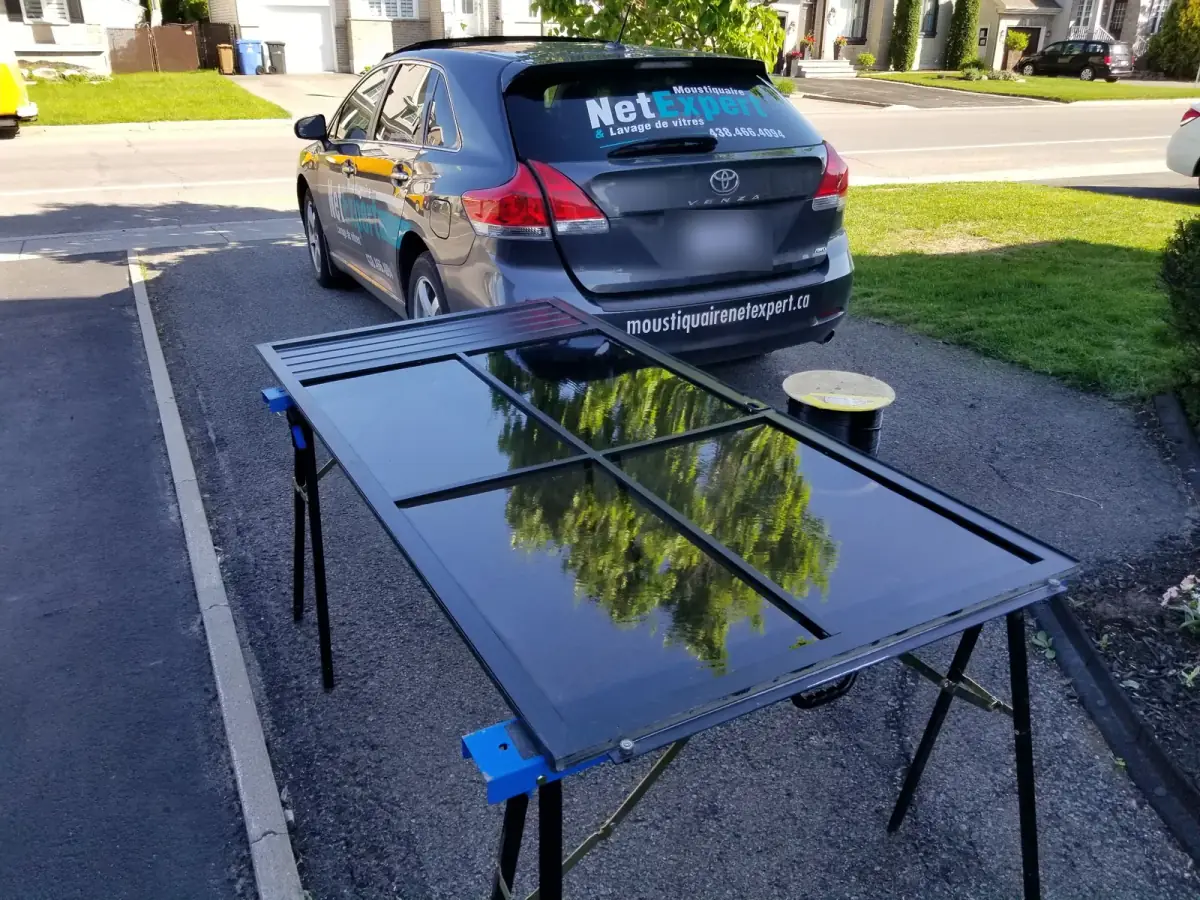
Gazebo and sun shelter specialty
Clear vinyl yellowed or torn? Replaced at your home in Saint-Michel, in the original frames — gazebos and sun shelters.
Three questions are enough to start. The official measurement is taken on site.
Whatever your retailer calls it — MICA film, clear vinyl, clear plastic, sun-shelter transparent fabric — it is the same material, and we replace it in Saint-Michel in your existing panels.
Sun yellows and clouds the vinyl. Film that crackles to the touch is at end of life.
Below freezing, MICA turns brittle — one handling or one gust splits it outright.
Slack vinyl flaps like a sail and eventually tears at the seams.
In Saint-Michel, where a gazebo ends up depends first on where the house was built. Around the church, the old village offers short lots and yards closed in by neighbouring buildings and a few mature trees: what goes up there is usually a small retailer gazebo, on a wooden deck or a paver patio. Step outside the village and the picture flips entirely. The bungalows on large lots and the scattered market-garden farms have yards with no visible edge, no hedge or fence to break anything, and the gazebo sits there like an isolated object in open space.
On a working market farm, the structure is more often permanent: wooden posts raised on site, a roofed top, and panels whose dimensions were decided by whoever built it rather than by a catalogue. That kind of gazebo serves as the summer dining room and the place to catch your breath after a day in the fields; it gets used deep into the season, which is exactly why clear vinyl (MICA film) makes sense there — it keeps the space usable once the evenings turn cool. The small village gazebo, by contrast, is more often left bare or stored for winter. Two uses, two ways of wearing out panels.
In open country, the film does not die of old age, it dies of wind. A loosely tensioned pane starts to flap with every gust; the vinyl works at the same spot every time, usually along an edge or a fastening point, and one October day the split starts there. Sun finishes the job: yellowing, then stiffening, and stiff vinyl forgives nothing. Screen panels last longer, but the same pressure eventually slackens them and pushes the spline out of its channel. We redo the film pane by pane at the frame's exact dimensions, and rescreen the panels in that same frame: it is correct tension, not a thicker material, that makes the whole thing last.
Access is not the difficulty in this kind of yard: ground level, no steps, and room to work beside the structure. Two things do need to be known ahead of time. The first is size — panels on a custom-built farm structure are often larger than anything sold in a store, and an oversized panel is carried by two people, never folded. The second is the address itself: a house out on a concession road, several kilometres from the village, gets planned into the same run as nearby work rather than an improvised round trip.
A yard bordered by fields has no windbreak at all, and that single fact drives everything else. Wind crosses through, the film flaps, and fibreglass mesh tires faster than it would elsewhere: on the exposed faces, aluminum mesh holds its tension better. The ditches that edge the fields hold standing water long after a rain, and mosquitoes follow: on the panels of a summer dining room, a tight weave is not a luxury. As for timing, the film goes on before the first cold snaps, while the vinyl is still supple and takes tension cleanly.
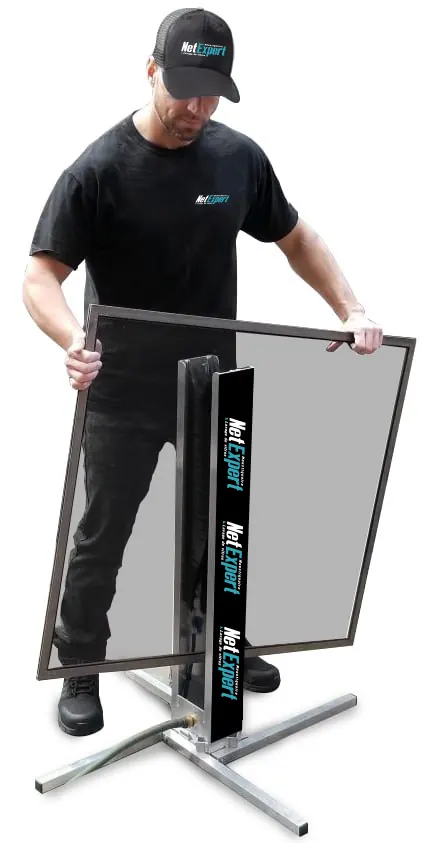
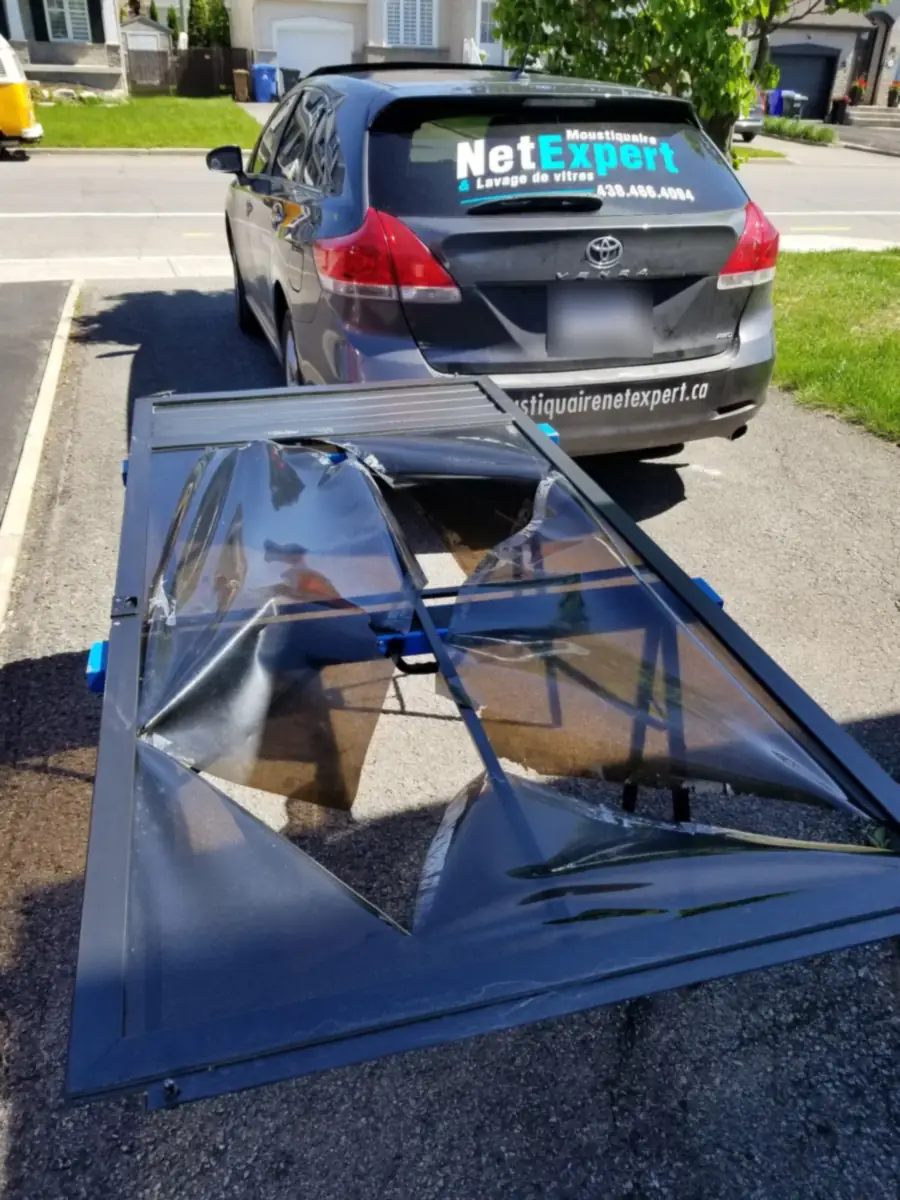
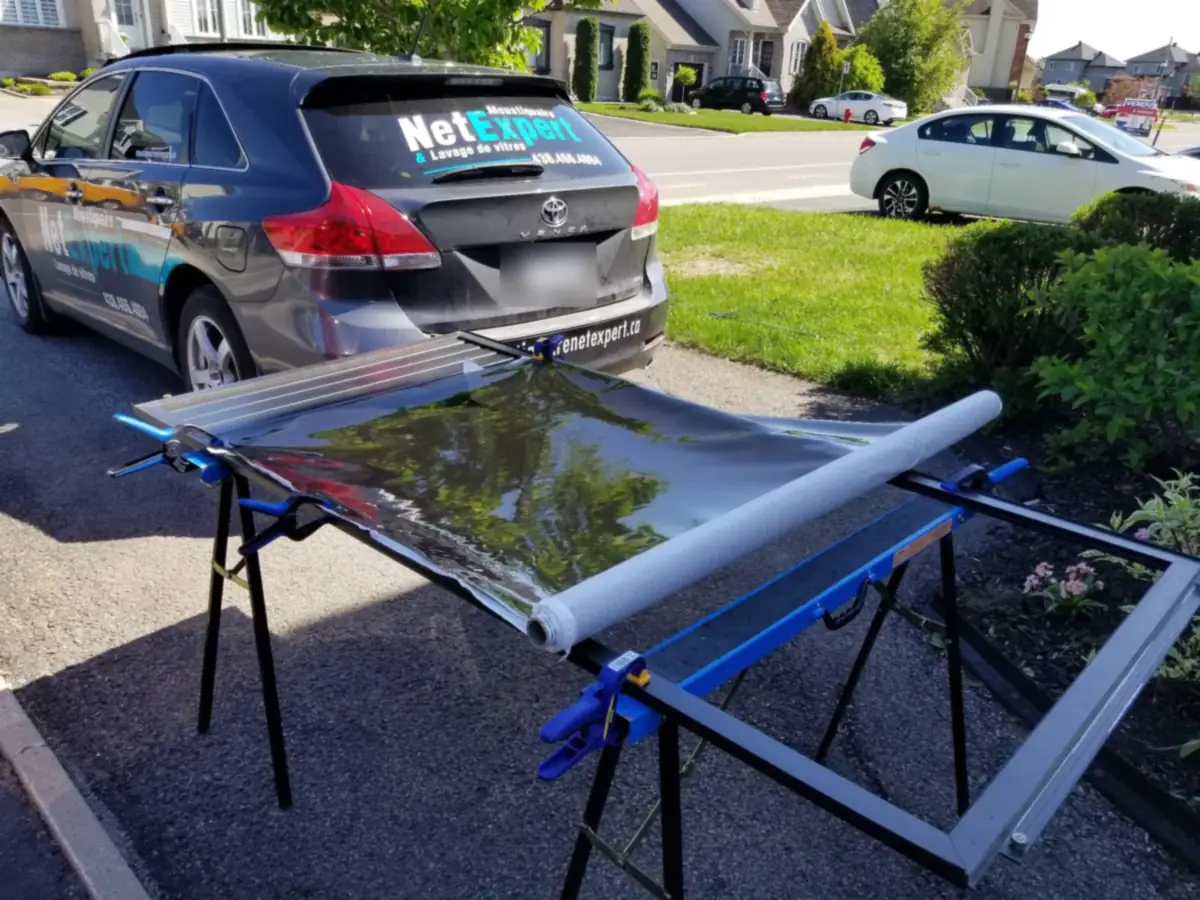
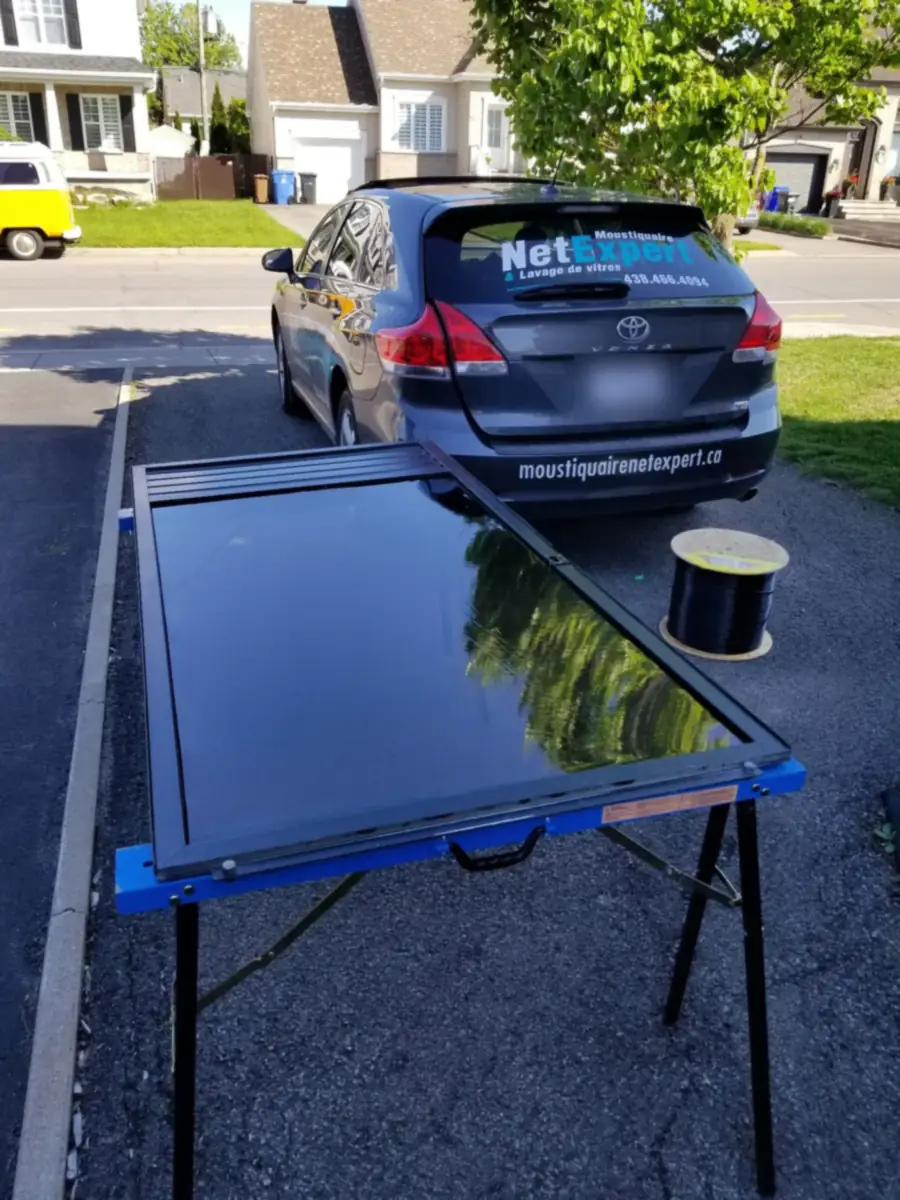
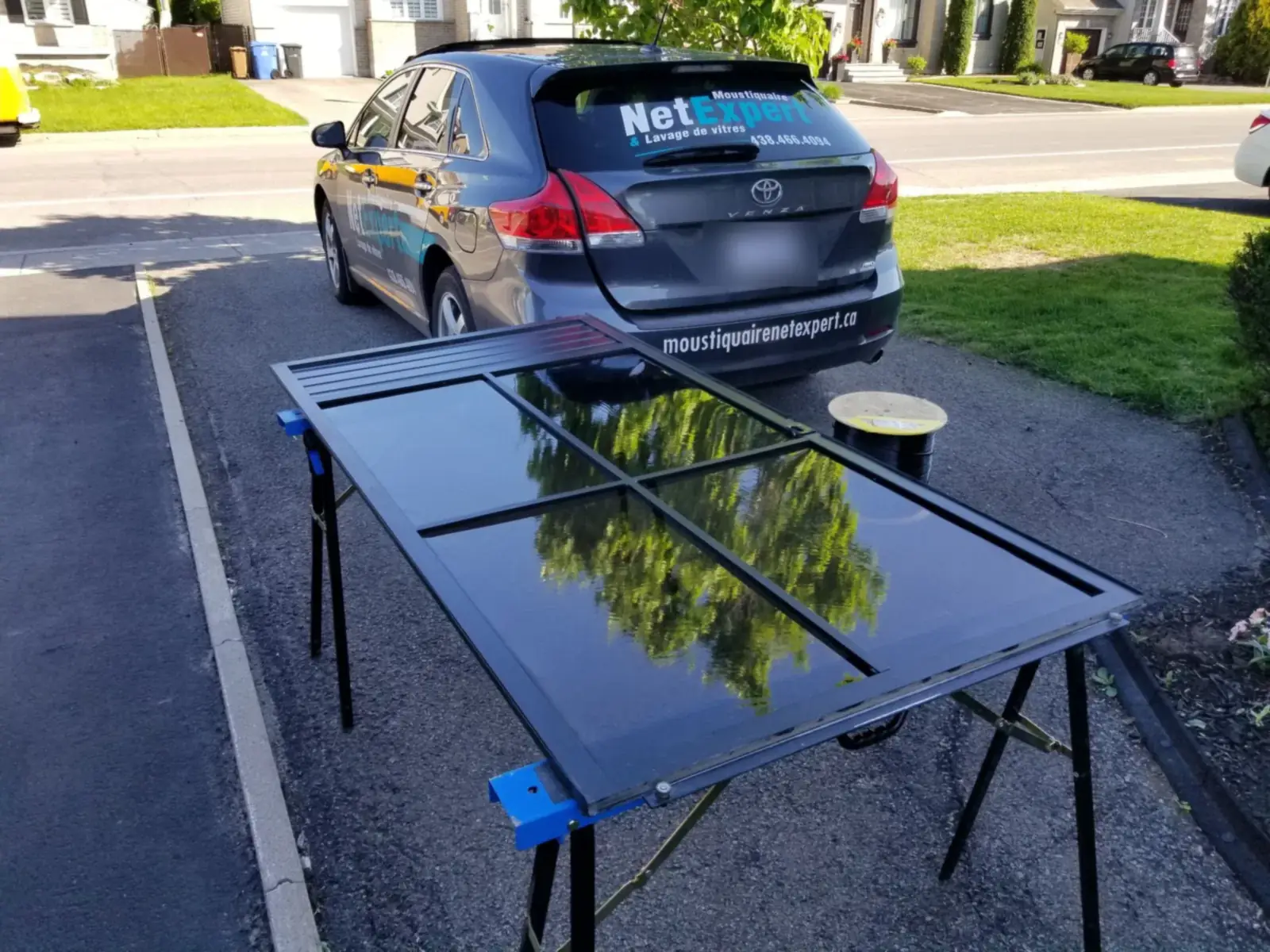
This job was not in Saint-Michel — it shows our method, the same everywhere: panels down, new vinyl pane by pane, panels back up.
« Ludovic replaced my screen in record time. Professional, and with a great sense of humour. I recommend his services — don’t hesitate to contact him, he’ll come to your home and do beautiful work. »
« Excellent service. Clear explanations of the work to be done. I really appreciated his dedication: despite the rain he insisted on finishing the job, soaked through and still smiling. The work was very well done. »
« Great service! He was at my neighbour’s and agreed to fix my back screen even though we had no appointment. Very successful repair, and inexpensive! »
Straight answers
It is the most common scenario on open ground, and it is not a question of vinyl quality. A pane cut too tight or fastened without even tension flaps in every gust, and the split always begins at the same point. Film redone to the frame's exact size and tensioned evenly no longer works at that spot.
Rarely, because at that stage it is no longer dirt. A film of soil lifted by field work does not rinse off: it settles in, and the cloth that moves it dulls the vinyl a little more with every pass. The film is then replaced pane by pane in the frame, without touching the screen panels.
Yes, and that is precisely why measuring happens on site rather than over the phone. Each oversized panel is recorded, removed, redone in its original frame, then refitted. What changes is handling: a large panel takes two people and is never folded, since a fold marks the vinyl permanently.
Yes, at your home. We travel to Saint-Michel, remove the panels, replace the MICA vinyl in the original frames and put everything back — the gazebo structure is never touched. It is one of our specialties.
Yes. Depending on the retailer it is called MICA film, clear vinyl, clear plastic or transparent fabric — the same flexible material that cuts wind and holds warmth. We replace it on gazebos and sun shelters alike.
Yes. The vinyl is replaced pane by pane, in the existing frame — no need to redo the whole panel for one tear. If several panes have yellowed, doing them together gives a uniform result.
On assessment: the price depends on the number of panels and their dimensions. The quote is free, and a photo is often enough to price without a visit. Fabrication and installation guaranteed one year.
Do you manage a building or a business in Saint-Michel?