
Summer UV
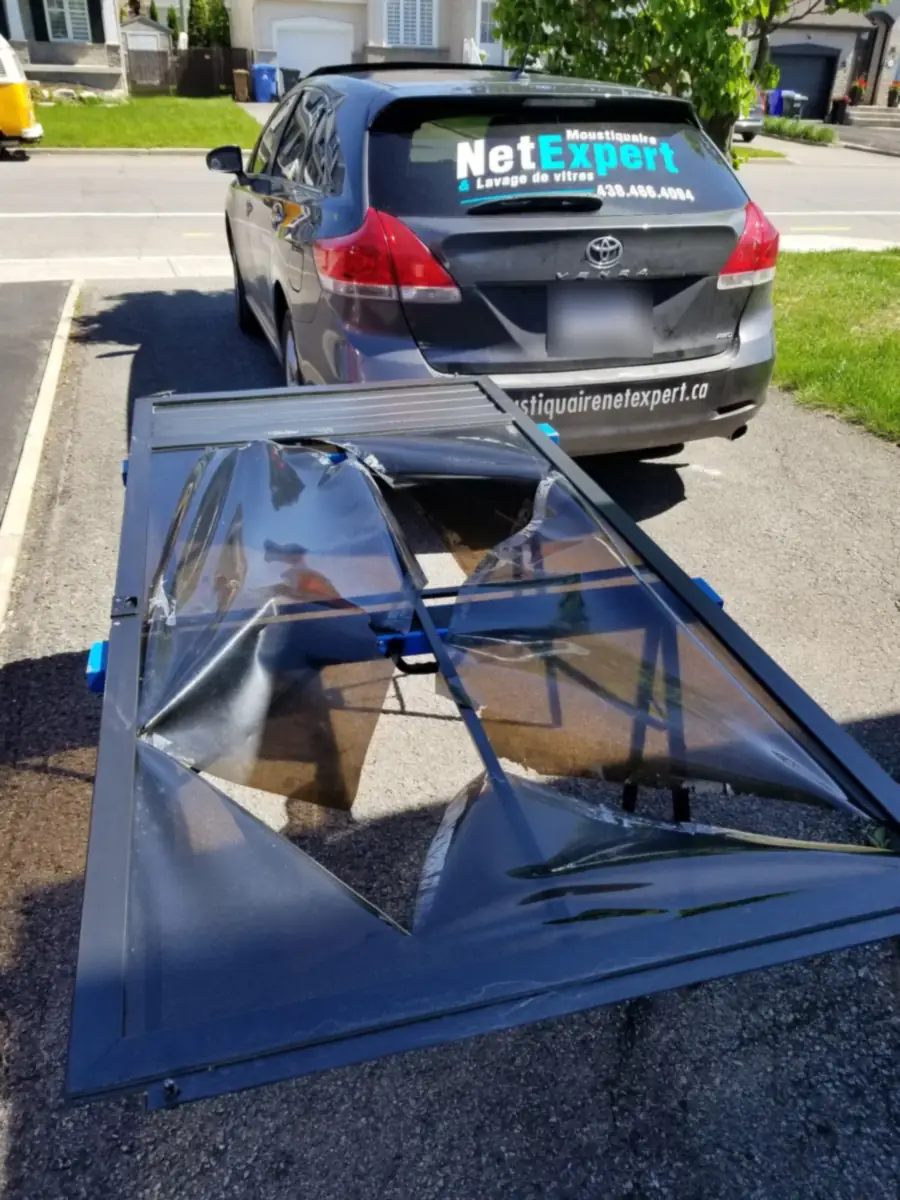
Sun yellows and clouds the vinyl. Film that crackles to the touch is at end of life.
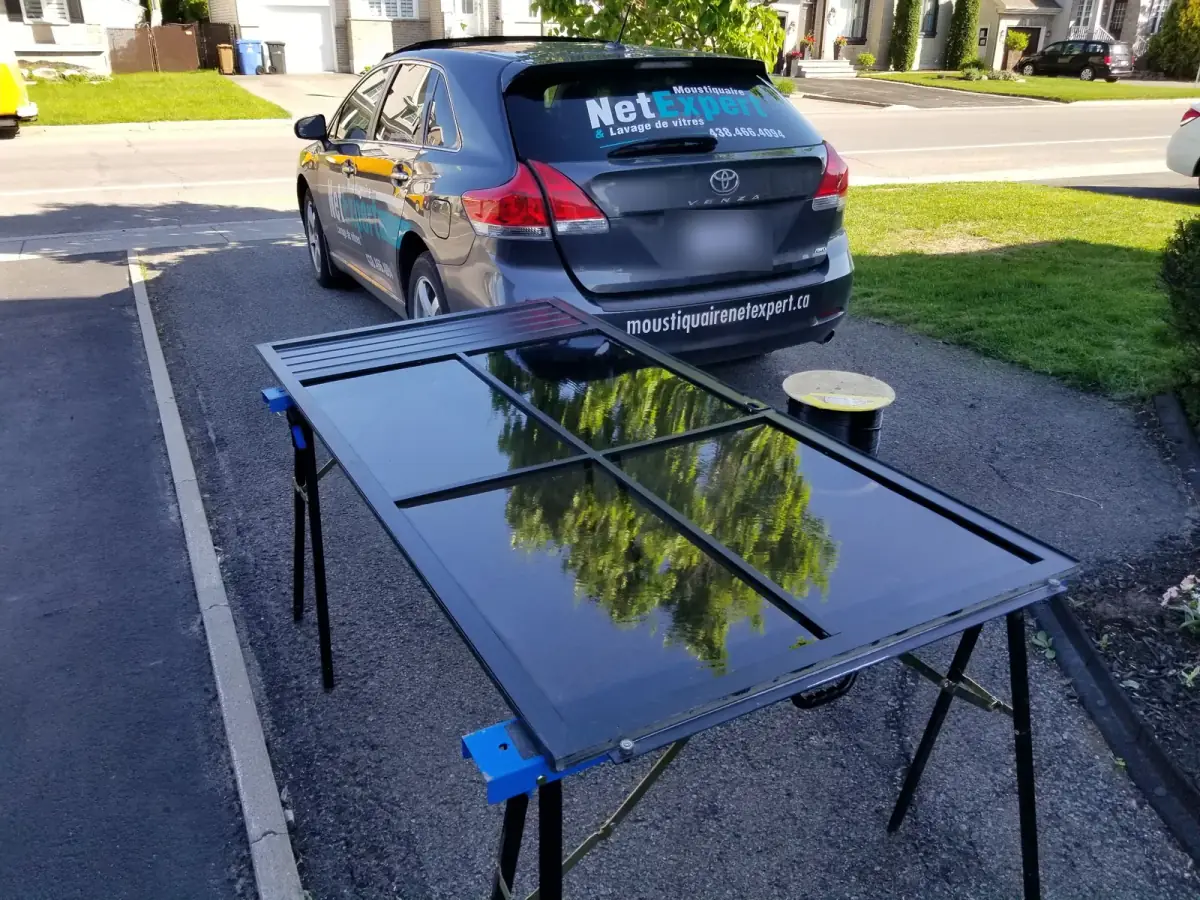
Gazebo and sun shelter specialty
Clear vinyl yellowed or torn? Replaced at your home in Saint-Jean-sur-Richelieu, in the original frames — gazebos and sun shelters.
Three questions are enough to start. The official measurement is taken on site.
Whatever your retailer calls it — MICA film, clear vinyl, clear plastic, sun-shelter transparent fabric — it is the same material, and we replace it in Saint-Jean-sur-Richelieu in your existing panels.
Sun yellows and clouds the vinyl. Film that crackles to the touch is at end of life.
Below freezing, MICA turns brittle — one handling or one gust splits it outright.
Slack vinyl flaps like a sail and eventually tears at the seams.
In Saint-Jean-sur-Richelieu, most backyards belong to the bungalows and semi-detached houses built between 1960 and 1990, and the patio door added at the back nearly always opens onto a patio. That patio is where the retail gazebo took root: an aluminum or steel frame, standard-format screen panels, clear vinyl (MICA film) for May and September evenings. That postwar stock holds most of the city’s backyards, and the retail gazebo in them always has the same weakness: a film that, after a few winters outdoors, has lost its suppleness and splits in the first strong wind.
The Richelieu changes everything along its banks. On a riverfront lot a gazebo is not exposed the same way: the wind comes straight off the water with nothing to slow it. A permanent wooden structure built for the view carries one-of-a-kind panels, often larger than a boxed model’s and slower to take down. In Vieux-Saint-Jean and Iberville, the 19th-century brick houses have deep, narrow yards ringed by walls and fences, where a gazebo is almost always a wooden addition built long after the house. Two more worlds beyond the suburban yard, and two ways of measuring: to matching standard dimensions for retail, frame by frame on site for wood.
On the retail gazebos of the 1960–1990 neighbourhoods, the film comes first, remade one pane at a time, each cut to the measure of its original frame; the screening follows, rescreened in its frame once it has let go at a corner or lost its spline. On the Richelieu, film does not die of old age but of wind: it flaps, pulls free of a fastener, then rips all at once. On those panels, film fitted very tight and stiffer aluminum mesh hold up better than fibreglass that bellies out. In Vieux-Saint-Jean, the panels of a wooden structure are rescreened under their mouldings, frame by frame, without a single post being moved.
A riverfront lot slopes toward the water, and the gazebo sits on the view side, which is the side farthest from the street: panels come down on the spot and travel back up the driveway one at a time to the mobile workshop. In Vieux-Saint-Jean, reaching the yard of a brick house often means a narrow passage between two walls or a trip through the house itself, which dictates the size of panel that can be brought out without twisting it. The suburban retail gazebo is the simplest: clipped panels, open yard, repeated formats. In all three cases we never touch the structure, only what hangs on it.
Wind is the first fact of a gazebo on the Richelieu: nothing slows it over the water, and a tired film gives way there in a single gust. Insects are the second fact, and a gazebo takes them differently than a window does: you sit in it a whole evening, a few metres from a bank with nothing to break the approach. On the lower panels, the ones in front of you, a finer weave shows immediately; on the high panels it costs airflow for nothing. Farther from the river, in the suburban yards, direct sun is what yellows the film and weakens fibreglass; the film goes up before the first cold and comes down in spring if the gazebo sits in full sun.
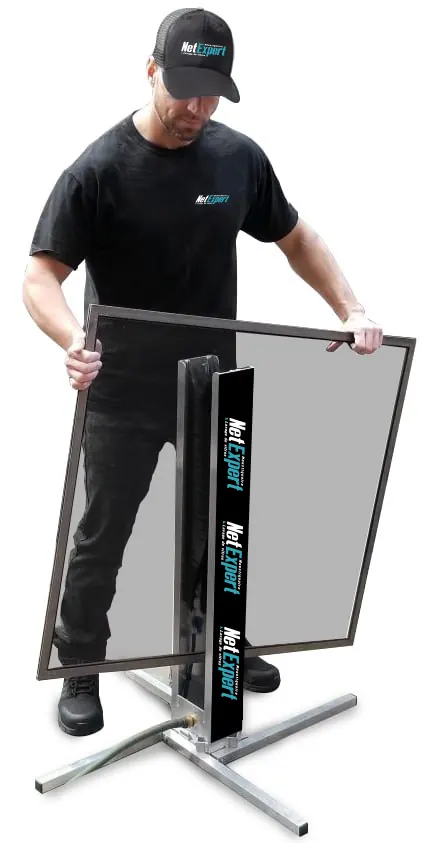
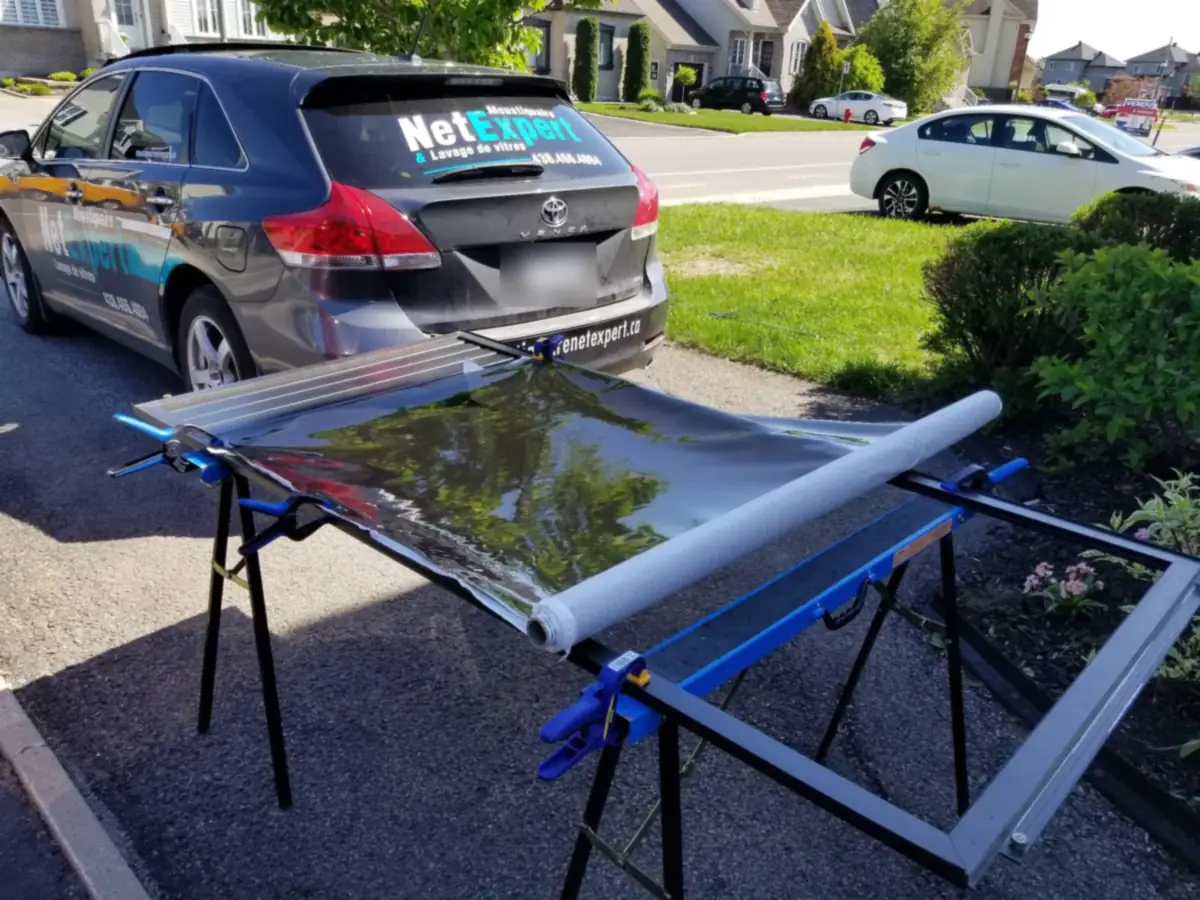
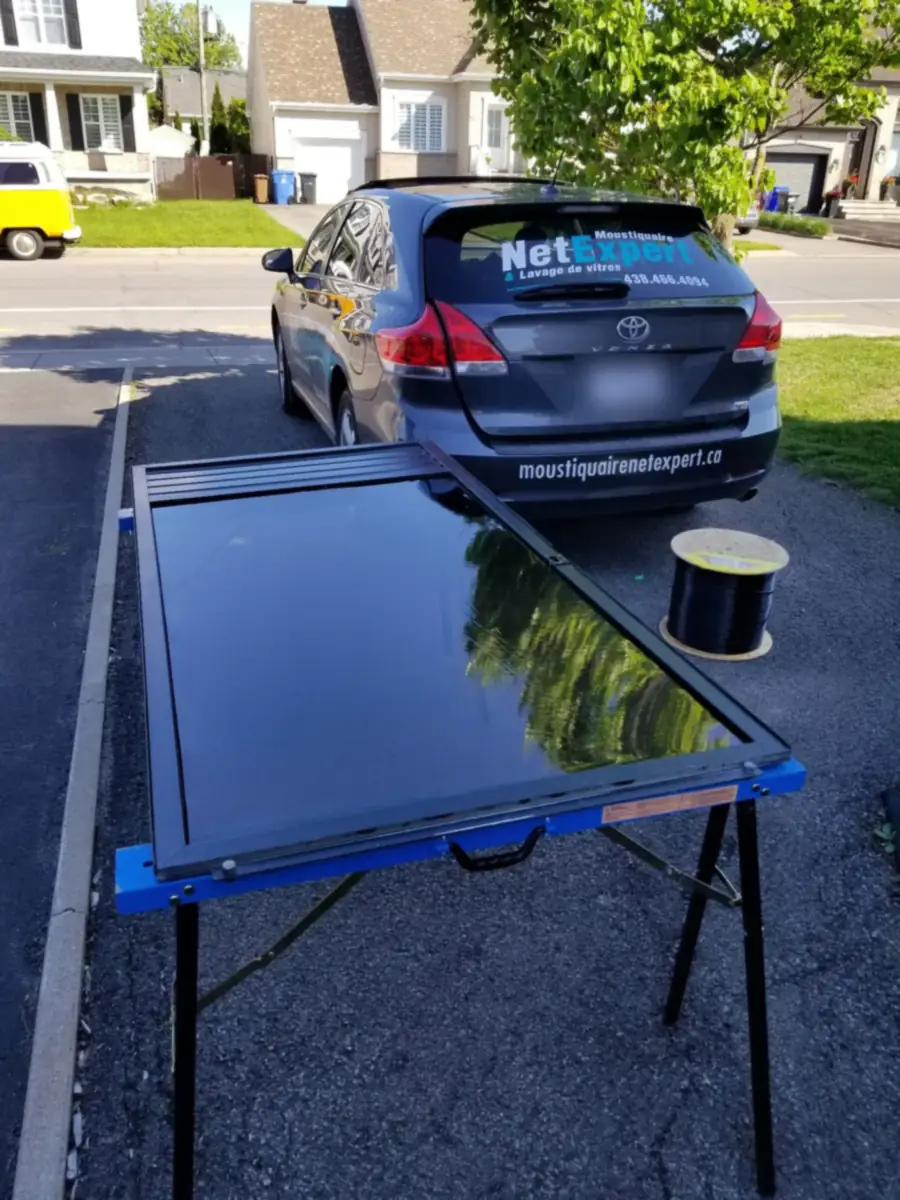
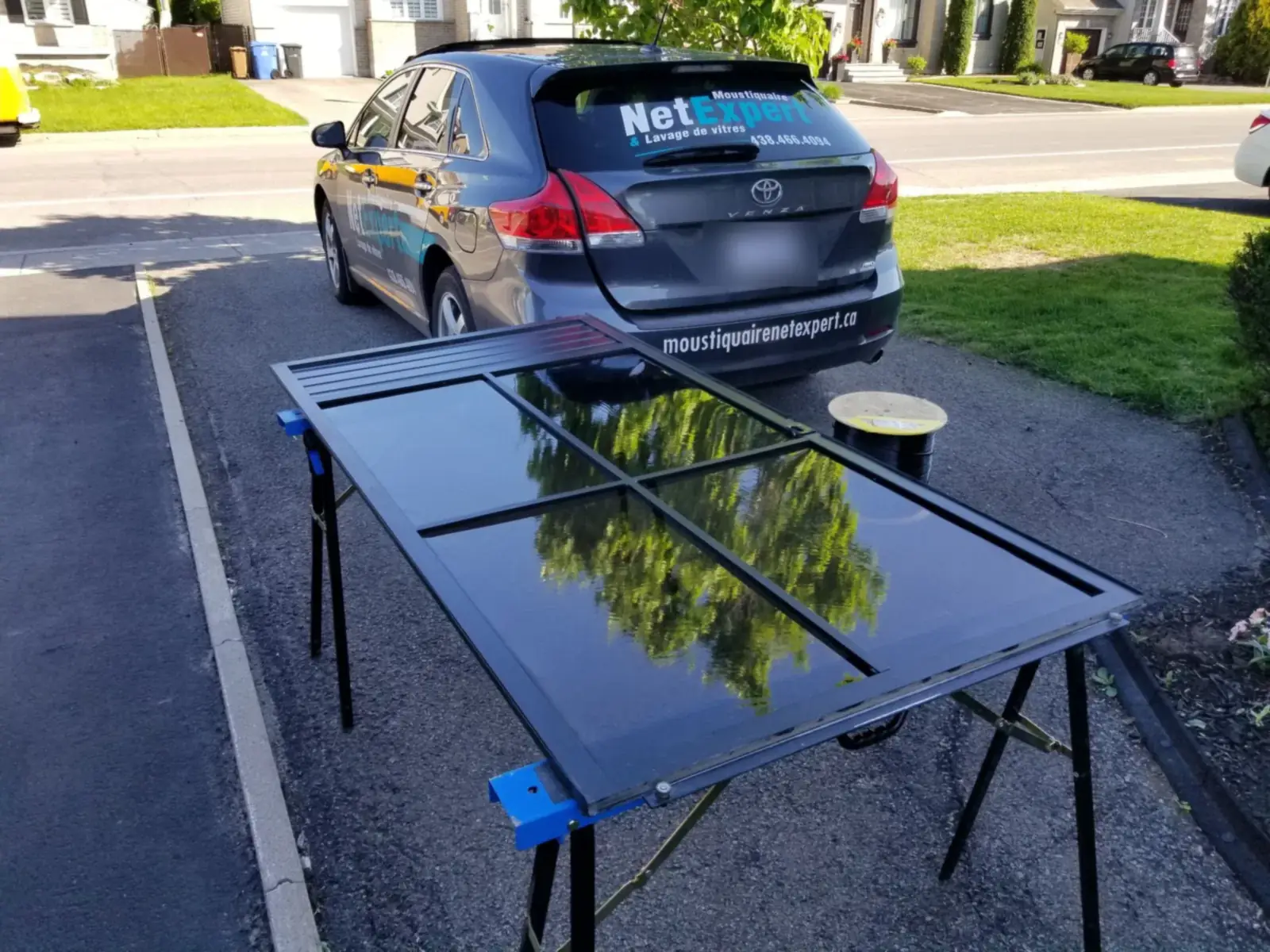
This job was not in Saint-Jean-sur-Richelieu — it shows our method, the same everywhere: panels down, new vinyl pane by pane, panels back up.
« Excellent service. Clear explanations of the work to be done. I really appreciated his dedication: despite the rain he insisted on finishing the job, soaked through and still smiling. The work was very well done. »
« Great service! He was at my neighbour’s and agreed to fix my back screen even though we had no appointment. Very successful repair, and inexpensive! »
« Ludovic replaced my screen in record time. Professional, and with a great sense of humour. I recommend his services — don’t hesitate to contact him, he’ll come to your home and do beautiful work. »
Straight answers
On the water it is the wind that kills it, not the cold. Film fitted with slack flaps with every gust, pulls free of a fastener, then rips. We remake it to the exact size of each pane, fitted very tight in the frame, and add fastening points where it was catching the wind. It will hold better, with no change to the structure.
Yes. A large panel comes down with two people, lies flat and is rescreened like a small one: the mesh is tensioned along its full length and then fixed under the original mouldings. What matters is the order of removal and a flat spot to lay it on, which a sloping riverfront lot does not always offer — we plan the space during the visit. The structure does not move.
Usually. An aluminum frame bent by a gust or a fallen branch straightens if the metal is not cracked, and once trued, it takes new mesh or new film like any other. If a corner has broken, a frame in the same standard format replaces it and the rest of the gazebo stays as it is. The structure is never involved.
Yes, at your home. We travel to Saint-Jean-sur-Richelieu, remove the panels, replace the MICA vinyl in the original frames and put everything back — the gazebo structure is never touched. It is one of our specialties.
Yes. Depending on the retailer it is called MICA film, clear vinyl, clear plastic or transparent fabric — the same flexible material that cuts wind and holds warmth. We replace it on gazebos and sun shelters alike.
Yes. The vinyl is replaced pane by pane, in the existing frame — no need to redo the whole panel for one tear. If several panes have yellowed, doing them together gives a uniform result.
On assessment: the price depends on the number of panels and their dimensions. The quote is free, and a photo is often enough to price without a visit. Fabrication and installation guaranteed one year.
Do you manage a building or a business in Saint-Jean-sur-Richelieu?