
Summer UV
Sun yellows and clouds the vinyl. Film that crackles to the touch is at end of life.
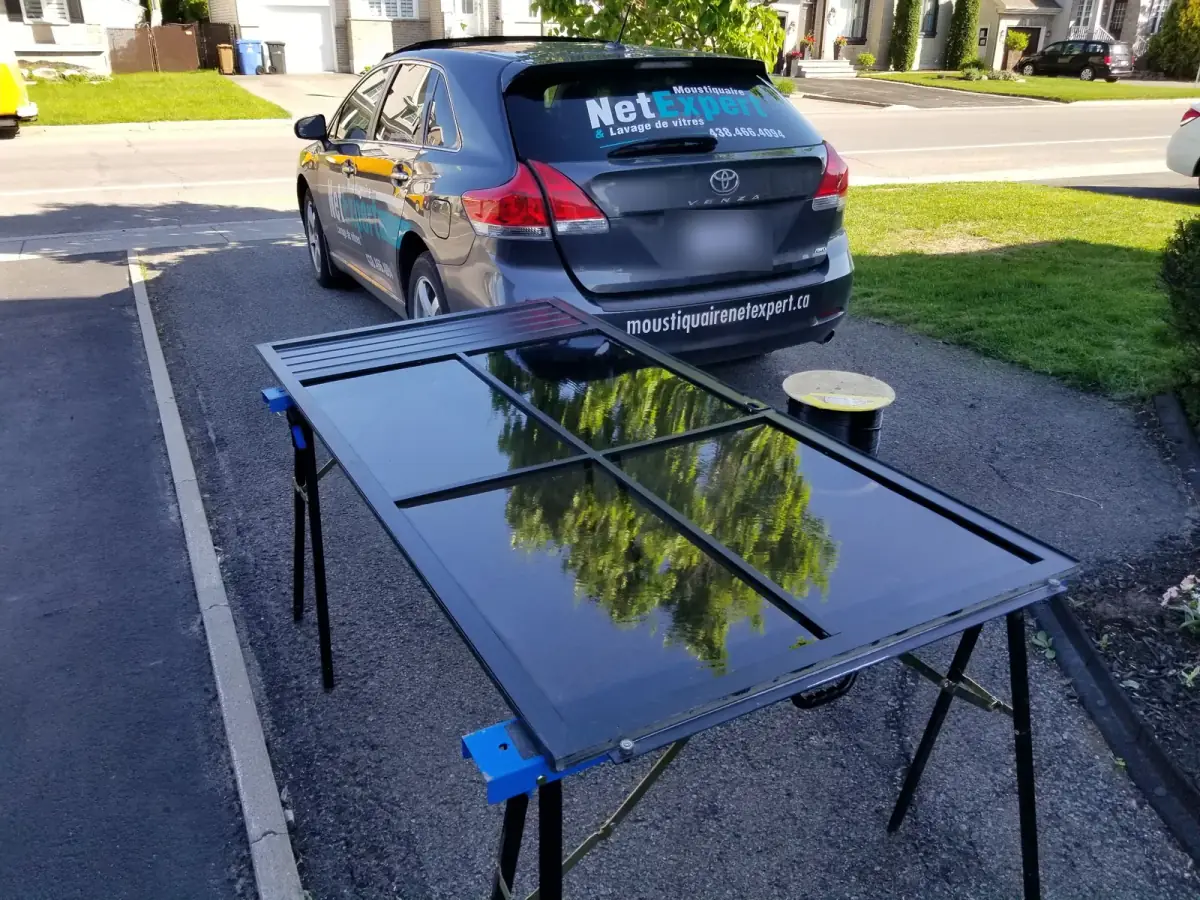
Gazebo and sun shelter specialty
Clear vinyl yellowed or torn? Replaced at your home in Montréal-Est, in the original frames — gazebos and sun shelters.
Three questions are enough to start. The official measurement is taken on site.
Whatever your retailer calls it — MICA film, clear vinyl, clear plastic, sun-shelter transparent fabric — it is the same material, and we replace it in Montréal-Est in your existing panels.
Sun yellows and clouds the vinyl. Film that crackles to the touch is at end of life.
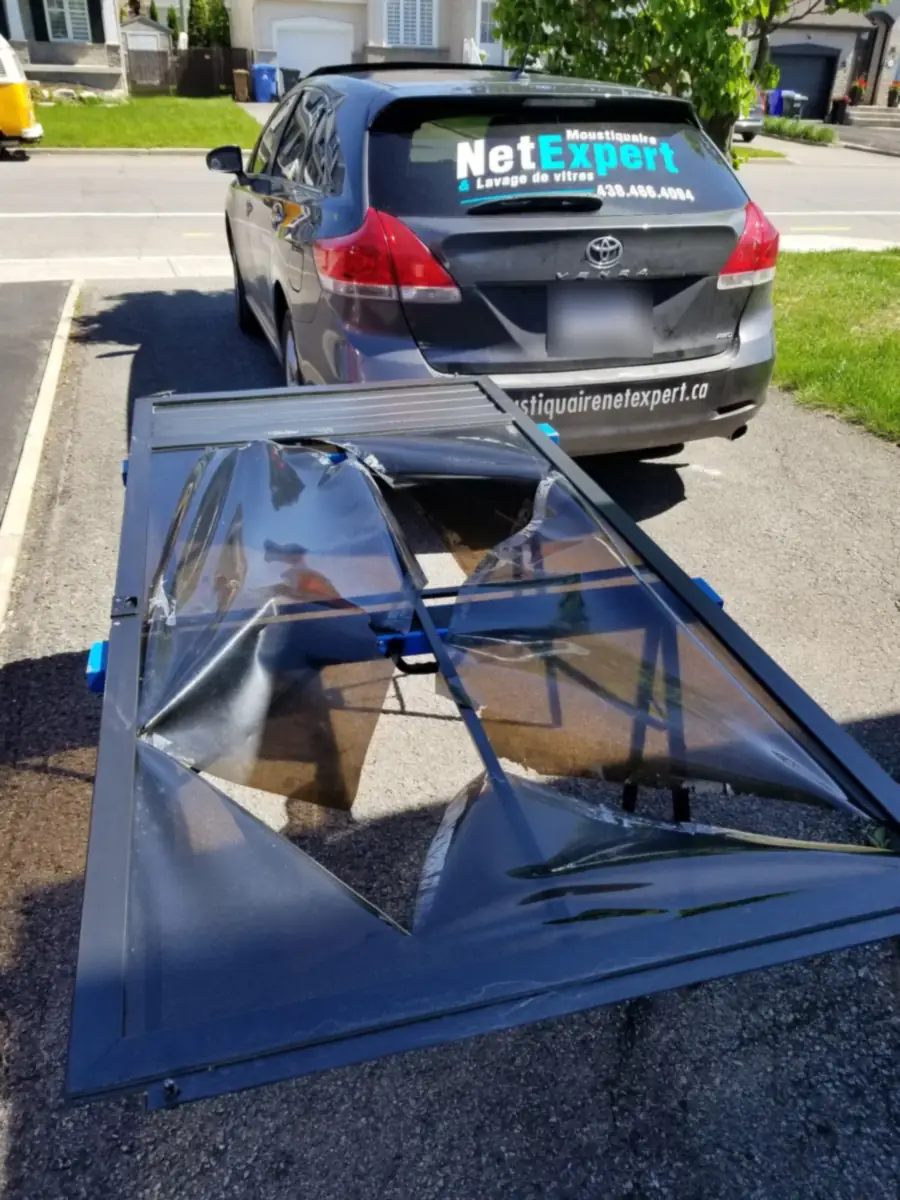
Below freezing, MICA turns brittle — one handling or one gust splits it outright.
Slack vinyl flaps like a sail and eventually tears at the seams.
Montréal-Est is a small city and its yards show it. The single-family homes and brick duplexes built between 1940 and 1960 take up a good share of their lots; what is left behind them is a modest yard, usually bounded by a chain-link fence, a garage or a shed. The gazebo that goes in it is almost always a retailer model: aluminum or steel frame, standard panel sizes, set on a concrete pad or on a wood patio grafted onto the house. It was chosen to fit the space available as much as for the shade it gives. Nothing in this post-war housing stock was designed to carry a permanent structure, and very few exist.
The duplex adds its own wrinkle. When two households share the lot, the gazebo in practice belongs to whoever has direct access to the ground, and the upstairs unit's outside staircase often runs along the same side of the yard. The city itself is ringed by the industrial installations of the east end: yards are largely open, with little tree cover, and the air moving across them carries dust for much of the year. On grey screening that hardly shows. On clear film it shows immediately: it hazes over, it gets wiped, and it is the wiping as much as the sun that eventually turns it milky.
On a retailer gazebo of this kind the panes are removable: they slide into channels or clip onto the frame under pressure. The clear vinyl (MICA film) is what fails first. Yellowed, hardened by cold, it splits at the first autumn windstorm, usually starting at a grommet or at a fold creased during storage. We rebuild it pane by pane, at the exact dimensions of the original frame — not to a catalogue size, because a model sold ten years ago no longer has a catalogue. The screening lasts longer: it tears at a corner, goes slack, or its spline lifts out of the groove after a few seasons under tension. It gets rescreened in the same frame, and the aluminum structure stays up throughout.
Space around the structure is the real constraint. Between the fence, the shed and the wall of the house there is not always room to lay a pane flat to work on, and the route out to the street runs along the house in a narrow corridor: that is how each panel travels to the mobile workshop and back. In a duplex yard there is also the question of who owns the gazebo and who authorizes taking it apart, particularly when the upstairs staircase passes right beside it. None of this prevents the work; it only sets how many panels are handled at once and where the vehicle goes.
With no trees overhead, a gazebo takes the sun full on, and that is the leading cause of film aging: it yellows, then it loses its flexibility. Wind moves freely through these open yards and works a loosely tensioned pane until it tears. Film installed properly tensioned before the first cold snaps lasts considerably longer. On the screening side the local constraint is deposit, not insects: the upper panels of a gazebo cannot be rinsed from the ground, and mesh left loaded all season eventually slackens under the weight. Aluminum is still the better call on large exposed panes, because it keeps its tension when the wind pushes against it.
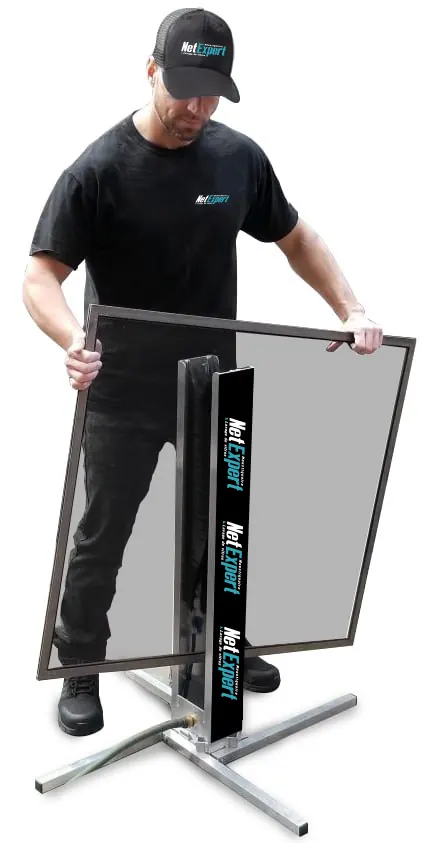
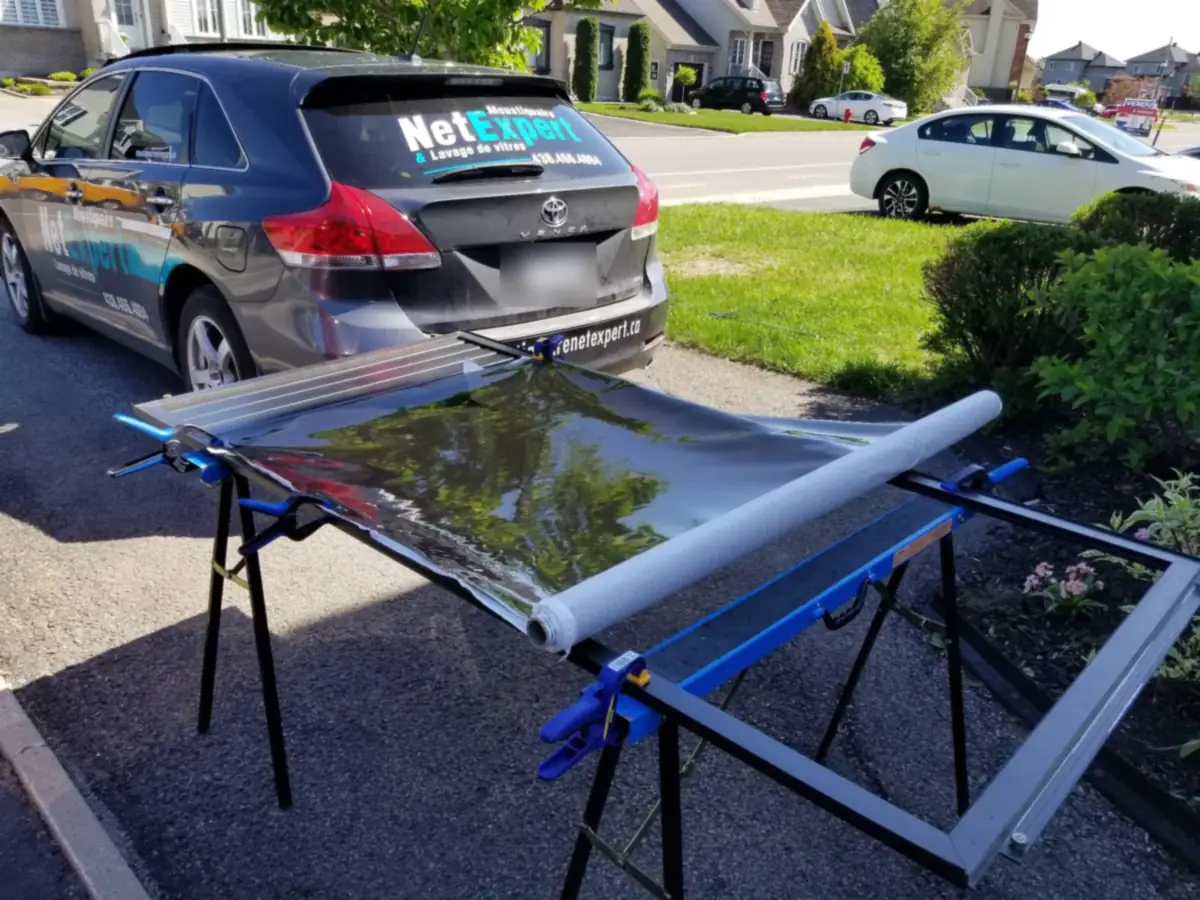
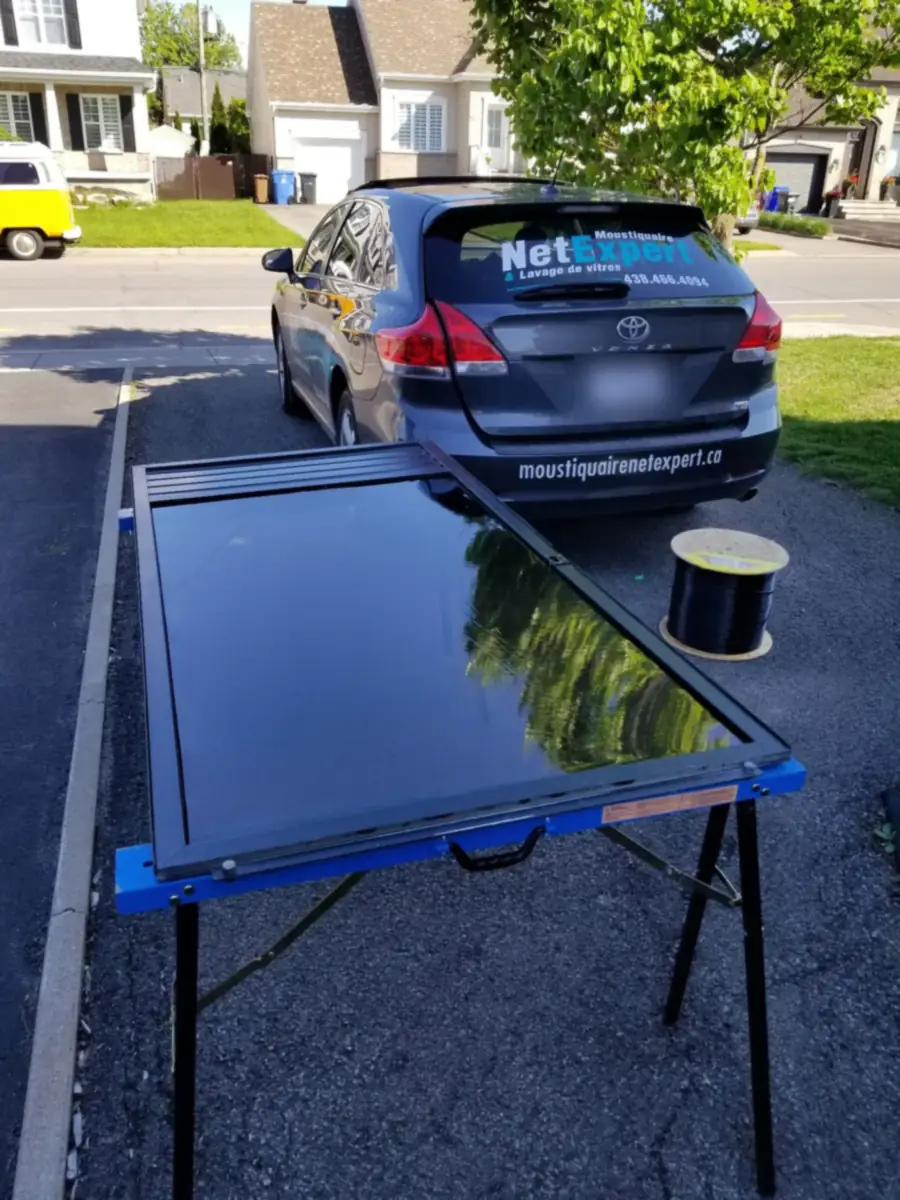
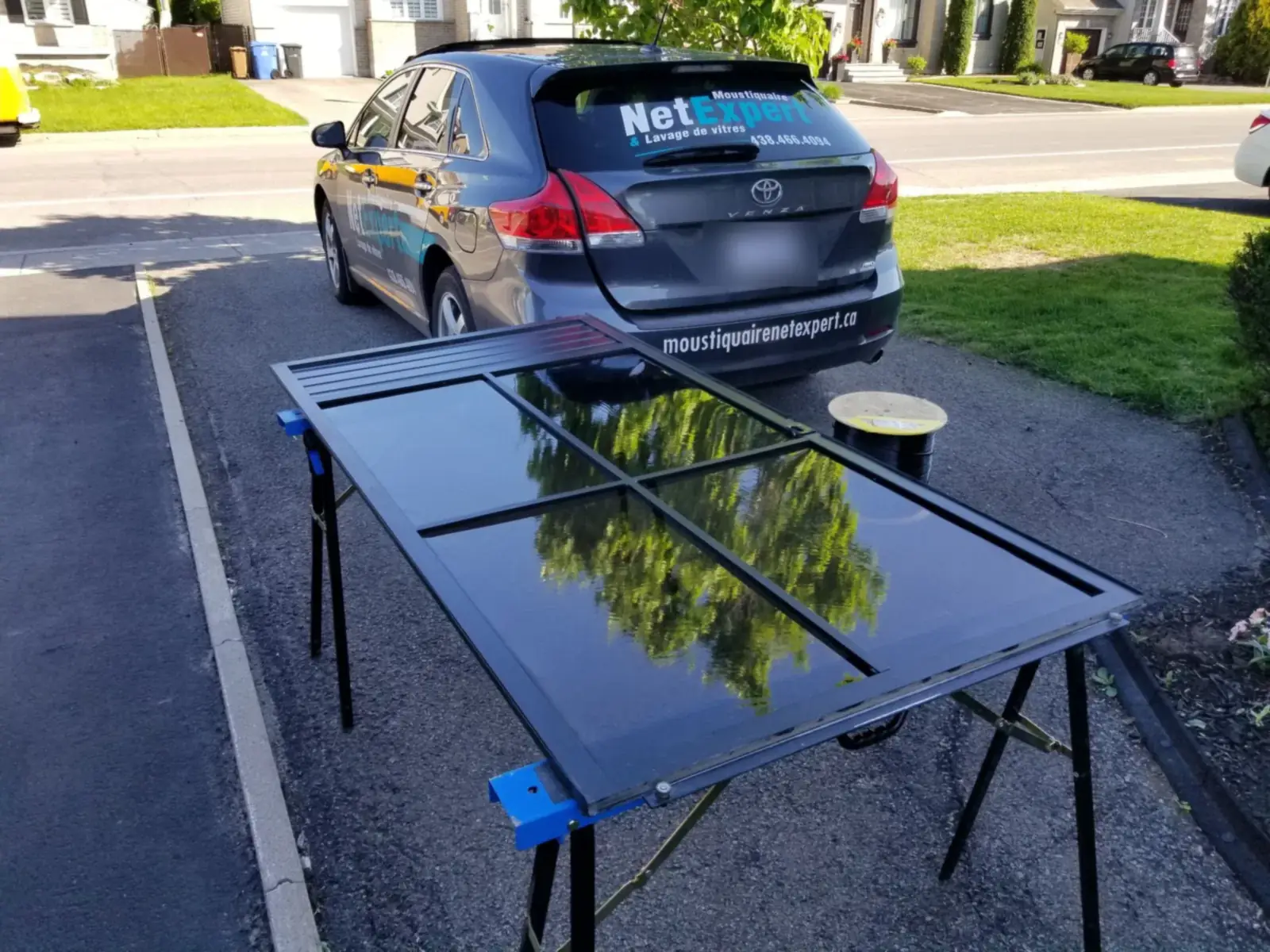
This job was not in Montréal-Est — it shows our method, the same everywhere: panels down, new vinyl pane by pane, panels back up.
« Great service! He was at my neighbour’s and agreed to fix my back screen even though we had no appointment. Very successful repair, and inexpensive! »
« Ludovic replaced my screen in record time. Professional, and with a great sense of humour. I recommend his services — don’t hesitate to contact him, he’ll come to your home and do beautiful work. »
« Excellent service. Clear explanations of the work to be done. I really appreciated his dedication: despite the rain he insisted on finishing the job, soaked through and still smiling. The work was very well done. »
Straight answers
No. Vinyl that has been scrubbed is scratched at the surface, and those scratches scatter light: no product removes them. The pane is rebuilt, at its exact dimensions, in the frame that is already there. Going forward, what keeps new film clear longest is rinsing and wiping it gently rather than rubbing it with a dry cloth full of dust.
That is the most common situation and it causes no trouble: the pane's frame is still good, only the film or the screening is finished. We measure the frame, cut the film or mesh to that dimension, fit it in, and the pane goes back onto the structure. The model being off the catalogue changes nothing about the work itself.
Not in itself. Panels leave one at a time along the side corridor, and they only need the path clear at the moment they are moved. What should be settled first is the agreement: knowing whether the upstairs or downstairs household owns the structure, and confirming that taking panels off is authorized. It is a five-minute question, but it belongs before the work, not during.
Yes, at your home. We travel to Montréal-Est, remove the panels, replace the MICA vinyl in the original frames and put everything back — the gazebo structure is never touched. It is one of our specialties.
Yes. Depending on the retailer it is called MICA film, clear vinyl, clear plastic or transparent fabric — the same flexible material that cuts wind and holds warmth. We replace it on gazebos and sun shelters alike.
Yes. The vinyl is replaced pane by pane, in the existing frame — no need to redo the whole panel for one tear. If several panes have yellowed, doing them together gives a uniform result.
On assessment: the price depends on the number of panels and their dimensions. The quote is free, and a photo is often enough to price without a visit. Fabrication and installation guaranteed one year.
Do you manage a building or a business in Montréal-Est?