
Summer UV
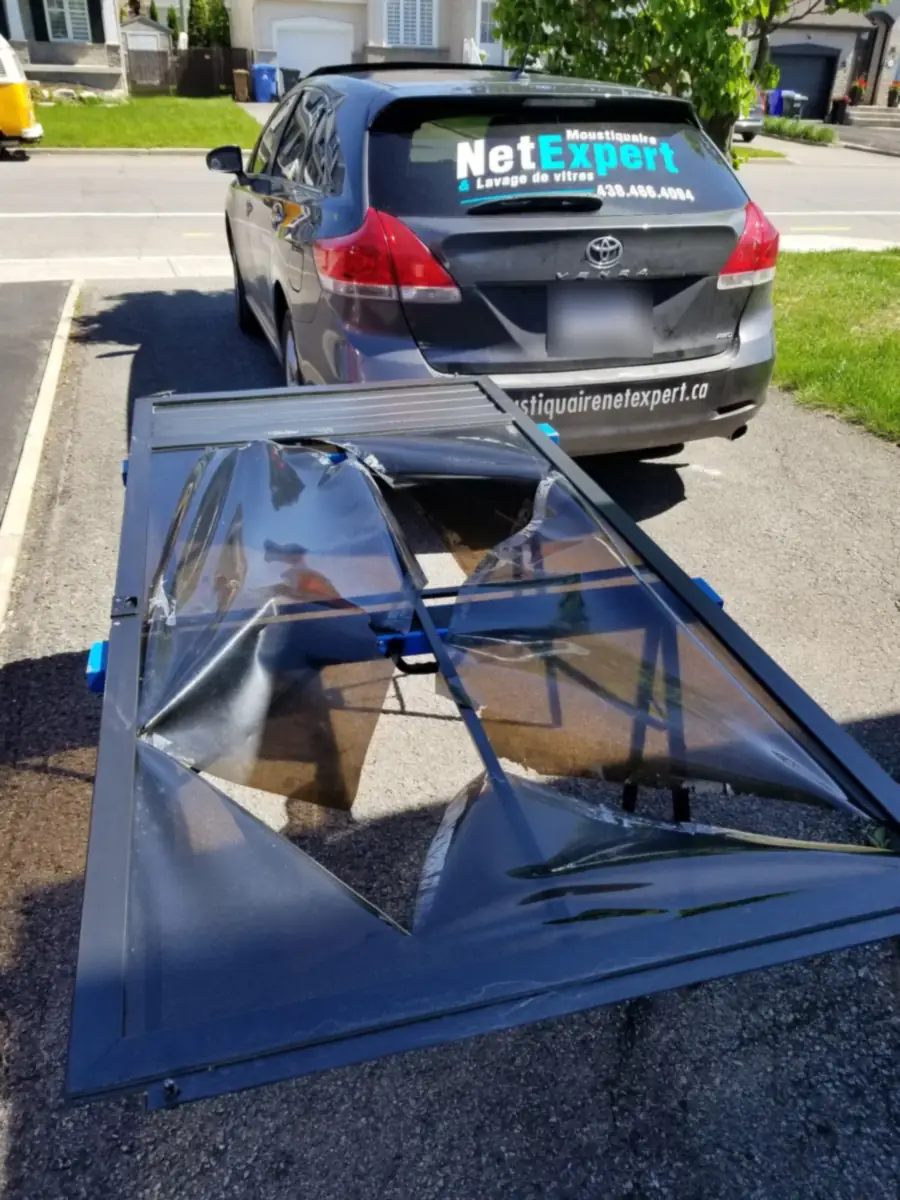
Sun yellows and clouds the vinyl. Film that crackles to the touch is at end of life.
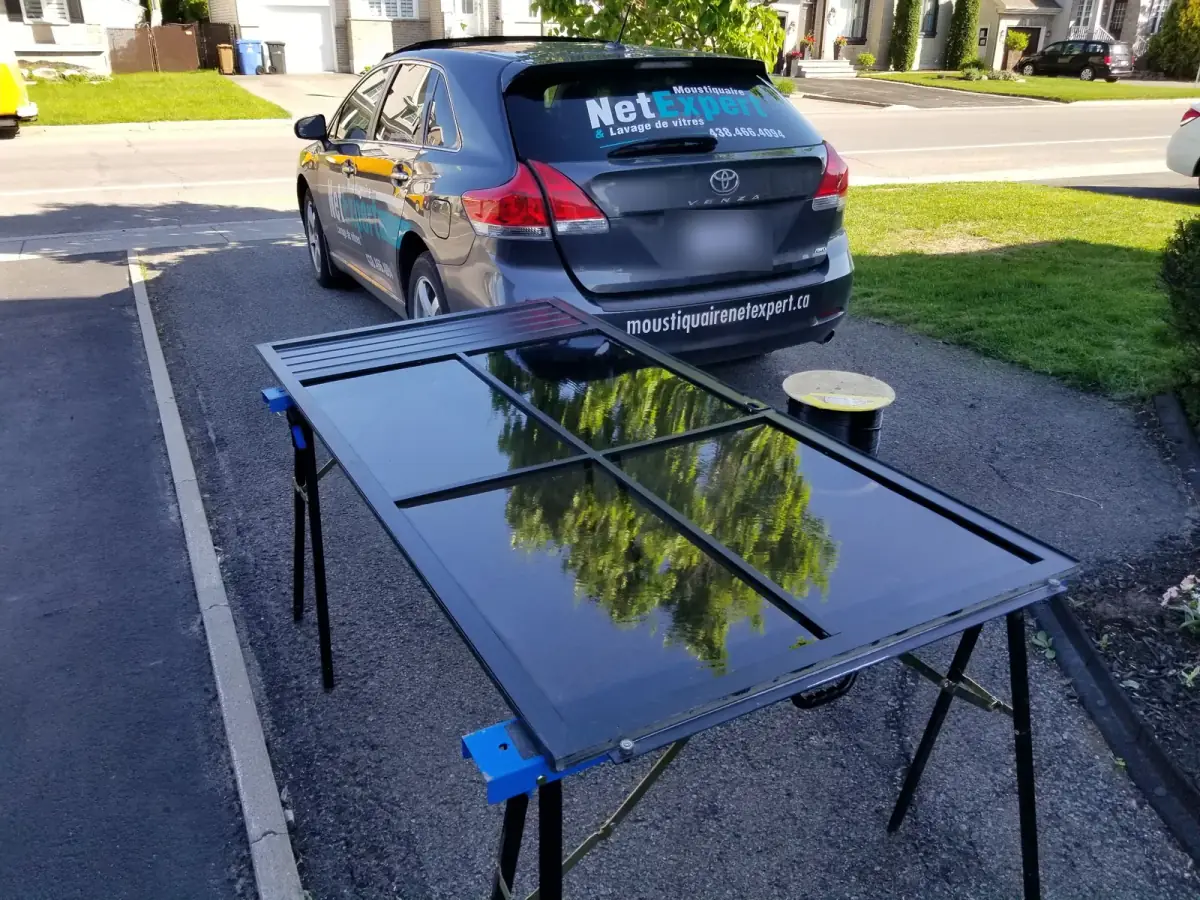
Gazebo and sun shelter specialty
Clear vinyl yellowed or torn? Replaced at your home in Noyan, in the original frames — gazebos and sun shelters.
Three questions are enough to start. The official measurement is taken on site.
Whatever your retailer calls it — MICA film, clear vinyl, clear plastic, sun-shelter transparent fabric — it is the same material, and we replace it in Noyan in your existing panels.
Sun yellows and clouds the vinyl. Film that crackles to the touch is at end of life.
Below freezing, MICA turns brittle — one handling or one gust splits it outright.
Slack vinyl flaps like a sail and eventually tears at the seams.
Noyan is a rural municipality, and its typical gazebo has nothing suburban about it. Along the concession roads, the farmhouses sit on large open lots, and whatever gets built for eating outdoors stands far from any windbreak: a retailer gazebo on a pad near the house, or a wood structure raised at the same time as a veranda. Along Missisquoi Bay the picture changes. The waterfront cottages that became year-round homes mostly have a covered space facing the water — sometimes a retailer model, often a permanent wood structure built to measure, its openings following the shape of the building rather than any catalogue size.
That difference drives everything else. A retailer gazebo has repeating panes, quick to measure; a wood structure near the water almost never has two identical openings, because it was closed in with whatever the carpenter had on hand and because it has usually been altered since. Because a waterfront cottage was usually closed in a few sides at a time, each face comes off by its own method, and it is on removal that a pane shows whether it wants film or screening. So every panel comes off at once, gets sorted between the ones needing new film and the ones needing new screening, and the work happens at the mobile workshop, in the yard.
On the bay, clear vinyl (MICA film) is not a late-year accessory: it is what makes the space usable when the wind comes up off the water. So it works hard, and it pays for it. The vinyl yellows in the sun, hardens in the cold, and a pane that has developed slack beats against its frame until it splits, almost always starting at a fastening point. It gets replaced at the exact dimensions of the frame, one pane at a time, with the structure untouched. On the screen side the enemy is tension: across the wide panel of a wood structure, fibreglass bellies out and eventually lifts from its groove. We rescreen it, and on the sides facing open water we switch to aluminum, which holds its shape.
On a permanent structure, every panel comes off its own way: screwed into a wood frame, slid into a rabbet, or held by turn buttons someone installed by hand. It unscrews, it gets rebuilt, it goes back — the frame itself never moves — but it takes a moment to understand the assembly before forcing anything. On a waterfront lot the other question is the ground: a lawn soaked through in spring, or a slope running toward the water, is not a concrete pad. The mobile workshop goes wherever the vehicle can sit, and it is the panels that travel, one at a time.
Shallow water bordered by wetlands means no-see-ums, and they are small enough to pass through standard mesh without even touching it. On a gazebo — a place where you sit still, late in the day, at exactly their hour — that is the strongest argument there is for a tight weave, even at the cost of some breeze. The wind coming up off the bay works against the film instead: nothing stops it on an open lot, and a loosely tensioned pane beats all night. On a lot with no windbreak, a pane has to be retensionable mid-season: that is why the fastening chosen here is one that can be redone point by point, rather than an assembly that would have to come apart entirely.
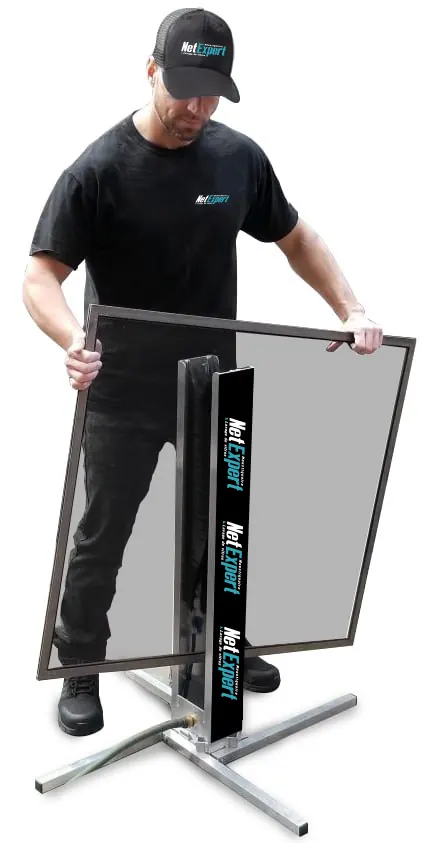
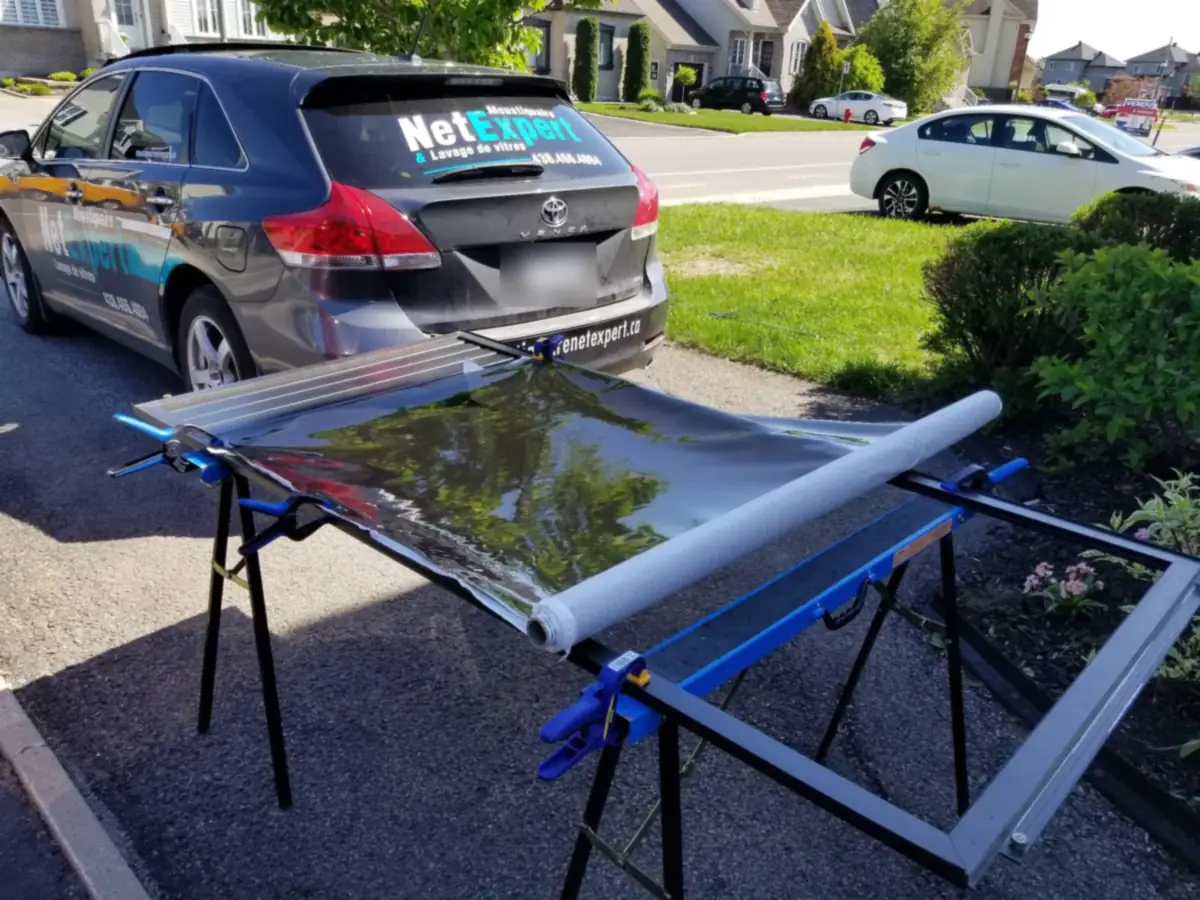
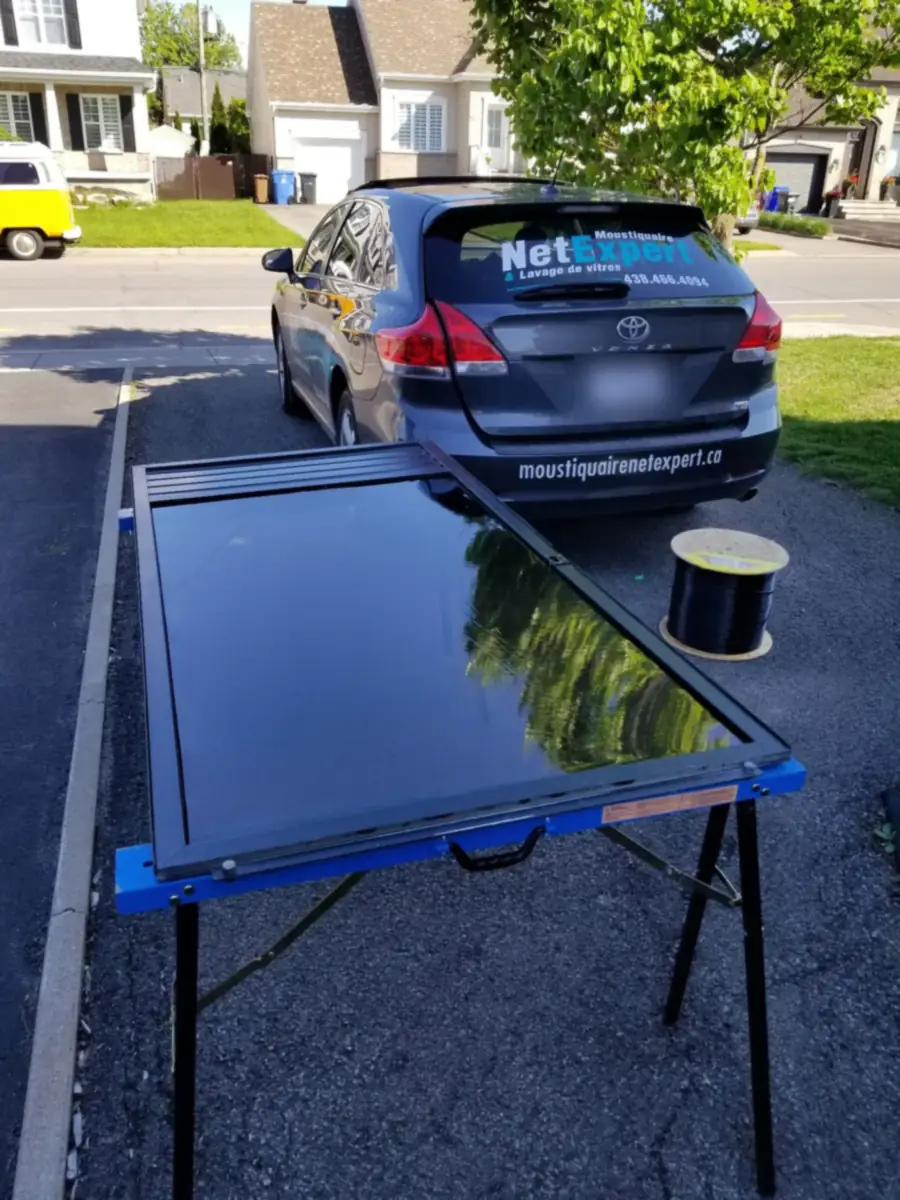
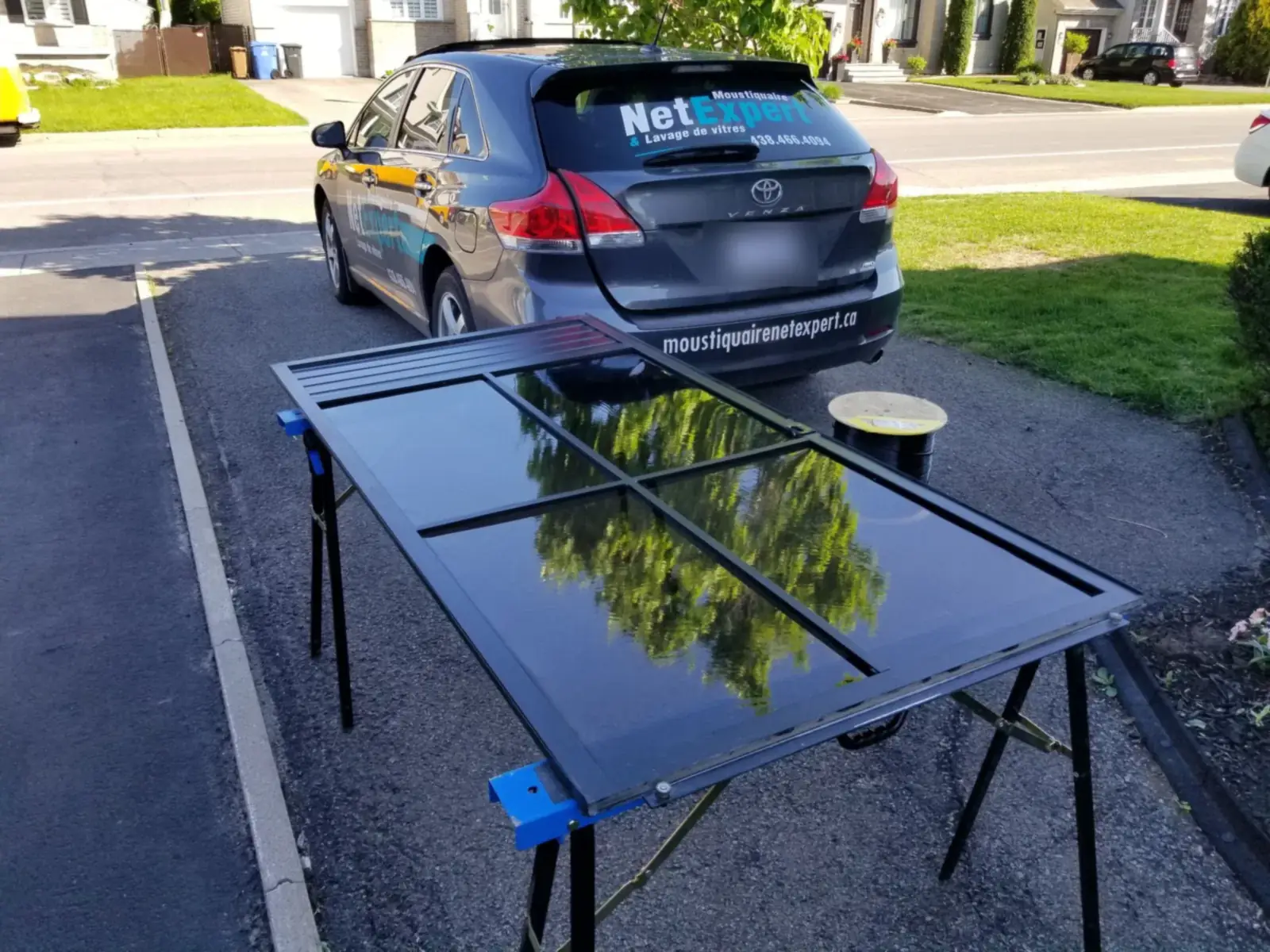
This job was not in Noyan — it shows our method, the same everywhere: panels down, new vinyl pane by pane, panels back up.
« Great service! He was at my neighbour’s and agreed to fix my back screen even though we had no appointment. Very successful repair, and inexpensive! »
« Ludovic replaced my screen in record time. Professional, and with a great sense of humour. I recommend his services — don’t hesitate to contact him, he’ll come to your home and do beautiful work. »
« Excellent service. Clear explanations of the work to be done. I really appreciated his dedication: despite the rain he insisted on finishing the job, soaked through and still smiling. The work was very well done. »
Straight answers
Yes, and it is the normal case here. Nothing gets ordered ahead: each pane is measured on site, on all four sides, and the film or screening is cut to that dimension to fit the existing frame. A structure closed in by hand and altered over the years has no reason to have two matching openings — it does not complicate the work, it shapes it.
Yes. A pane that flaps is a pane with slack in it, and the tear almost always begins at a fastening point that has worked loose. Redoing those points and reinstalling the film properly tensioned in its frame stops the movement. On a lot with no windbreak, that is the difference between film that gets through the winter and film that opens at the first autumn gale.
Because they are not coming through a hole — they are coming through the mesh itself. On a gazebo it shows more than anywhere else, because the sides are large and you sit still in them. The usual build is mixed: a tight weave on the two sides you sit on, standard mesh on the windward sides, so the air is not closed off along with the insects.
Yes, at your home. We travel to Noyan, remove the panels, replace the MICA vinyl in the original frames and put everything back — the gazebo structure is never touched. It is one of our specialties.
Yes. Depending on the retailer it is called MICA film, clear vinyl, clear plastic or transparent fabric — the same flexible material that cuts wind and holds warmth. We replace it on gazebos and sun shelters alike.
Yes. The vinyl is replaced pane by pane, in the existing frame — no need to redo the whole panel for one tear. If several panes have yellowed, doing them together gives a uniform result.
On assessment: the price depends on the number of panels and their dimensions. The quote is free, and a photo is often enough to price without a visit. Fabrication and installation guaranteed one year.
Do you manage a building or a business in Noyan?